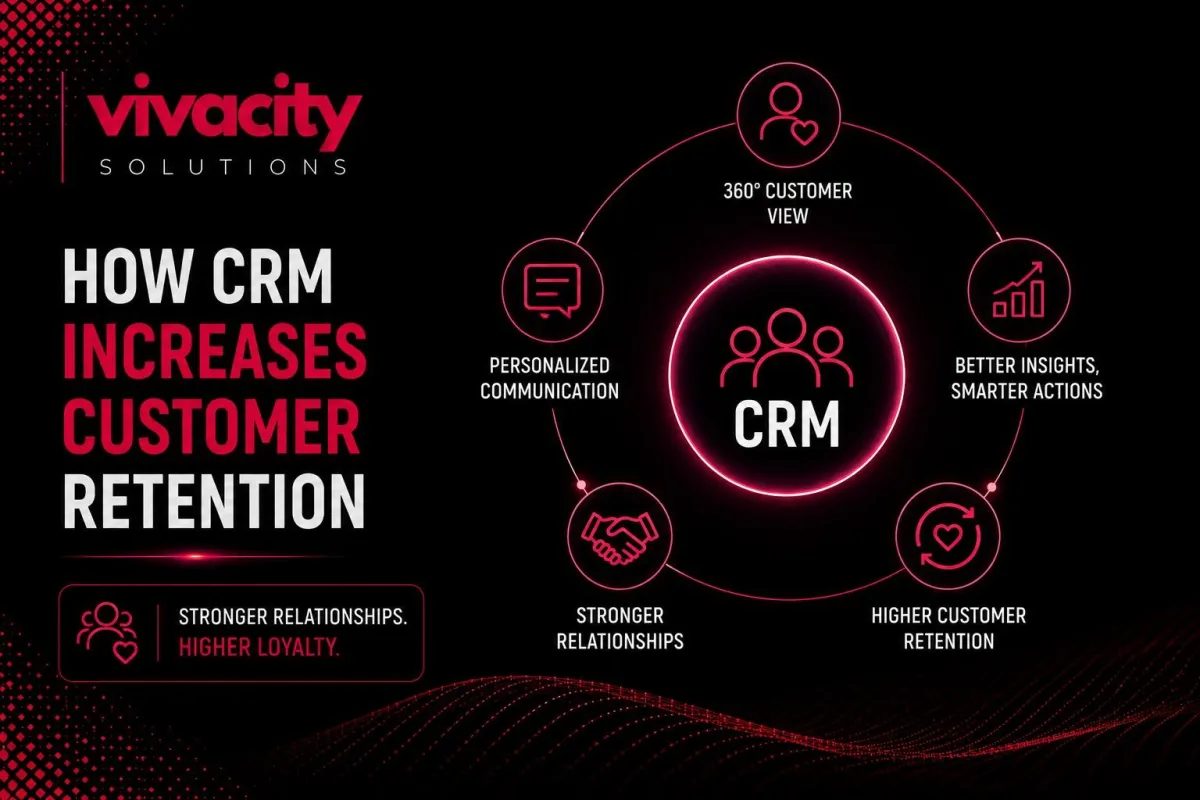
How CRM Increases Customer Retention
Here is a statistic that should grab every business owner's attention. Increasing customer retention by just 5% can increase profits by 25% to 95%. Yet most businesses spend 80% of their marketing budget on customer acquisition, while only 20% goes to retention.
Acquiring a new customer costs five to seven times more than retaining an existing one. And existing customers are 60‑70% more likely to buy from you again. The math is clear: retention is the key to sustainable business growth.
But retaining customers is not easy. It requires understanding their needs, anticipating their problems, and delivering consistent, personalized experiences. That is exactly where CRM for customer retention comes in.
What is the most effective way for CRM to increase customer retention?
Before we dive deep, let me answer this directly. The most effective way for a CRM system to increase customer retention is through five core capabilities.
Centralized customer data management gives you a complete view of each customer. Second, CRM automation delivers personalized communication at scale.
Third, churn prediction analytics flag at‑risk customers before they leave. Fourth,
proactive engagement and timely follow‑ups show customers you care. Fifth, integration with customer service and support tools ensures issues are resolved quickly.
This guide uses real‑world examples and proven strategies to help you use CRM for customer retention.
Written by Michael Vivacity, CRM Strategy Lead at Vivacity Solutions. I have helped over one hundred businesses reduce churn and increase retention using CRM strategies.
Why Customer Retention Matters for Business Profitability
Customer retention is the ability of a business to keep its existing customers over time. It is a direct measure of customer loyalty and customer satisfaction.
Customer retention matters because it is far more profitable than acquisition. Retained customers buy more, cost less to serve, and are more likely to refer others. They also provide valuable feedback and insights that help you improve your products and services.
The churn rate measures how many customers leave over a given period. High churn is a warning sign. It indicates that customers are not satisfied, not engaged, or not seeing enough value. Reducing churn is one of the most impactful things you can do for business profitability.
Customer retention also increases customer lifetime value (CLV). When customers stay longer, they generate more revenue over time. A customer who stays five years is worth far more than one who stays one year.
Research shows that a 5% increase in retention rate can increase profits by 25‑95%. That is a staggering return for a relatively small improvement.
If you are new to CRM fundamentals, understanding what is CRM is the first step. A strong CRM strategy focused on retention is the second.
What Is CRM for Customer Retention?
CRM for customer retention is the use of CRM software and CRM tools to build stronger relationships with existing customers, reduce churn, and increase customer loyalty.
A CRM system helps you centralize customer data, track every interaction, automate personalized communication, and identify at‑risk customers. It gives you a complete view of the customer journey – from first contact to ongoing service.
When you use CRM for customer retention, you move from reactive to proactive engagement. Instead of waiting for customers to leave, you anticipate their needs, solve problems before they escalate, and deliver consistent, personalized experiences.
CRM for customer retention is not just about technology. It is about a mindset shift. It is about recognizing that your existing customers are your most valuable asset and using CRM solutions to nurture those relationships.
CRM Features that support retention include customer history tracking, segmentation, automated follow‑ups, feedback collection, and analytics. CRM integration with support and marketing tools ensures a seamless experience across all touchpoints.
How CRM Reduces Customer Churn
Customer churn happens when customers leave because they are dissatisfied, disengaged, or find a better alternative. A CRM system helps you prevent churn in several ways.
First, CRM provides visibility. You can see every customer interaction, purchases, support tickets, communication history, and complaints. When you see a pattern of declining engagement or repeated complaints, you can intervene early.
Second, CRM enables proactive outreach. Instead of waiting for customers to call with problems, you can reach out first. A quick check‑in, a personalized offer, or a thank‑you message can make a huge difference.
Third, CRM automates retention campaigns. You can set up automated sequences triggered by specific behaviors. For example, if a customer has not purchased in 90 days, the CRM sends a re‑engagement email. If a customer complains, the CRM creates a task for a manager to follow up.
Fourth, CRM identifies at‑risk customers. Using CRM analytics and data analysis, you can identify customers who are likely to churn. These are customers with low engagement, negative feedback, or declining usage. You can prioritize them for outreach.
Fifth, CRM improves customer service. When support agents have a complete customer history, they can resolve issues faster. Faster resolution means higher customer satisfaction and lower churn.
Real example: A subscription‑based software company used its CRM to track usage patterns. They noticed that customers who did not log in for 30 days had a 60% churn rate. They set up an automated sequence: at day 25, a personalized email with tips and a check‑in. At day 40, a special offer. Churn dropped by 35%.
CRM and marketing automation tools are essential for these retention campaigns. CRM automation tools handle the repetitive work, so your team can focus on high‑value interactions.
Key CRM Features That Improve Customer Retention
Let me walk you through the specific CRM features that drive customer retention.
Centralized Customer Data Management
Customer data management is the foundation of retention. Your CRM system centralizes all customer information in one place. Every interaction, purchase, support ticket, and communication is logged.
With centralized data, every team member has a complete view of each customer. No more asking customers to repeat their story. No more siloed information. This leads to better service and stronger relationships.
CRM Features like contact management, interaction history, and activity tracking are essential. CRM integration with other systems ensures data flows automatically.
H3: Personalized Communication and Service
Personalization is one of the most powerful CRM tools for customer retention strategies. When customers feel understood and valued, they stay longer.
Your CRM system enables personalized service by storing customer preferences, purchase history, and communication preferences. You can tailor every interaction to the individual customer.
For example, a travel company using a CRM system might send personalized offers based on past destinations. A software company might send tips tailored to how the customer uses their product. This is data‑driven decisions in action.
CRM and marketing automation tools make personalization scalable. You can automate personalized emails, offers, and follow‑ups without manual effort.
Automated Follow‑Ups and Engagement
Automation ensures that customers never fall through the cracks. A CRM system can automate follow‑ups, reminders, and engagement campaigns.
For example, after a purchase, the CRM can automatically send a thank‑you email, request a review, and schedule a check‑in call. After a support ticket is resolved, the CRM can send a satisfaction survey.
Task automation and workflow management ensure that every customer receives consistent, timely communication. This builds trust and loyalty.
CRM automation tools are essential for scaling retention efforts. Without automation, you can only manage a limited number of relationships effectively.
Churn Prediction and Proactive Outreach
Churn prediction uses data analysis and real‑time data to identify customers who are likely to leave. Your CRM system can analyze behavior patterns – reduced usage, lower engagement, negative feedback – and flag at‑risk accounts.
Once you identify at‑risk customers, you can engage proactively. A personalized email, a discount offer, or a check‑in call can often prevent churn.
CRM analytics and CRM reporting dashboards can track churn risk across your entire customer base. This enables data‑driven decisions about where to focus retention efforts.
Customer Feedback and Satisfaction Tracking
Customer feedback is essential for retention. Your CRM system can collect feedback through surveys, support tickets, and direct communication.
Track customer satisfaction scores (CSAT) and Net Promoter Scores (NPS). Identify customers who are unhappy and intervene early. Use feedback to improve your products, services, and processes.
CRM Features like survey integration and feedback management help you collect and act on customer insights.
Integration with Support and Marketing Tools
CRM integration with customer service and marketing automation tools is critical for retention. When your CRM is connected to support and marketing systems, you get a complete view of each customer.
Support agents see the full customer history, enabling faster resolution. Marketing teams see customer behavior, enabling targeted campaigns. Sales teams see customer health, enabling proactive outreach.
CRM integration with support tools ensures issues are resolved quickly. CRM and marketing automation integration ensures consistent, personalized communication.
CRM integration mistakes can damage retention. Poor integration creates data silos and fragmented customer experiences.
Customer Retention Strategies Using CRM
Here are proven customer retention strategies that leverage your CRM system.
Strategy 1: Onboarding and welcome sequences. Use your CRM system to automate onboarding workflows. Send welcome emails, product tips, and check‑in reminders. Strong onboarding reduces early churn.
Strategy 2: Regular check‑ins and health checks. Schedule periodic check‑ins with key customers. Use CRM task automation to create reminders. Show customers you care about their success.
Strategy 3: Proactive issue resolution. Monitor support tickets and feedback. When you see a pattern of complaints, address it proactively. Use CRM data analysis to identify recurring issues.
Strategy 4: Personalized offers and rewards. Use customer data to create personalized offers. Reward loyal customers with discounts, exclusive content, or early access.
Strategy 5: Churn prevention campaigns. Identify at‑risk customers and launch targeted retention campaigns. Use CRM automation to personalize outreach based on the specific risk factors.
Strategy 6: Customer feedback loops. Collect feedback regularly. Act on it. Close the loop by telling customers what you did with their feedback. This builds trust and loyalty.
Strategy 7: Customer education. Use your CRM system to track customer knowledge gaps. Send educational content, tutorials, and best practices. Educated customers are more successful and stay longer.
For industry‑specific strategies, read CRM for service-based and How a CRM can change Your Real Estate Business.
How to Choose the Right CRM for Customer Retention
Not all CRM software is equally effective for customer retention. Here is how to choose.
First, prioritize customer data management. Your CRM system must centralize all customer information. Look for features like interaction history, activity tracking, and segmentation.
Second, evaluate automation capabilities. Can you automate follow‑ups, campaigns, and tasks? CRM automation tools are essential for scaling retention efforts.
Third, check analytics and reporting. Can you track customer satisfaction, churn rate, and retention rate? Look for CRM analytics dashboards that provide real‑time insights.
Fourth, assess integration options. Does the CRM integrate with your support, marketing, and billing systems? CRM integration is critical for a complete view of each customer.
Fifth, consider your team size and budget. The best CRM system for a small business may not be right for an enterprise. Choose a CRM software that fits your needs and resources.
Sixth, evaluate AI capabilities. In 2026, How Generative AI Is Transforming Modern CRM Systems is a key trend. AI‑powered CRM systems can predict churn, personalize outreach, and automate insights.
Generative AI in CRM can also help with personalized messaging and content creation for retention campaigns.
CRM Features like customer segmentation, automated workflows, and churn prediction are non‑negotiable for retention.
DIY vs. Working with a CRM Partner
Many business owners wonder whether to implement a CRM system themselves or work with a partner. Here is my perspective.
DIY CRM implementation can work if you have experienced staff and simple needs. However, most businesses struggle with CRM implementation, CRM integration, and CRM adoption. The result is often low retention gains.
Working with a CRM partner brings proven expertise, faster implementation, and higher success rates. A CRM development partner or CRM consultant can help you configure the system for retention, train your team, and optimize workflows.
CRM consulting services and CRM Development Services ensure your CRM system is set up correctly from the start. This reduces CRM implementation failures and maximizes retention impact.
For most businesses, the investment in professional CRM implementation pays for itself through improved retention and reduced churn.
Final Thought
Customer retention is the foundation of business profitability. Acquiring new customers is expensive. Keeping existing customers is profitable. And a CRM system is your most powerful tool for retention.
CRM for customer retention works by centralizing customer data, enabling personalized communication, automating follow‑ups, predicting churn, and integrating with support and marketing tools.
The businesses that use CRM for customer retention effectively achieve higher customer satisfaction, lower churn, and stronger business growth. They build lasting relationships with their customers.
If you are not using your CRM system for retention, you are leaving money on the table. Start today. Evaluate your CRM features. Build retention workflows. Track your metrics. And watch your retention rates improve.
For ongoing success, explore CRM Services that include consulting, implementation, and support. And always keep learning about CRM strategies as your business evolves.
FAQs
How does CRM help with customer retention?
CRM helps with customer retention by centralizing customer data, automating personalized communication, tracking customer interactions, identifying churn risks, and enabling proactive engagement. This leads to stronger relationships and higher retention rates.
What is the role of CRM in customer retention?
The role of CRM in customer retention is to provide a complete view of each customer, automate follow‑ups, deliver personalized service, identify at‑risk accounts, and enable data‑driven decisions that improve customer satisfaction and loyalty.
How does CRM reduce customer churn?
CRM reduces customer churn by flagging at‑risk customers based on behavior patterns (reduced usage, lower engagement, complaints). It enables proactive outreach, personalized retention campaigns, and timely support interventions.
What features of CRM improve customer retention?
Key CRM features for customer retention include customer data management, interaction history, automated follow‑ups, churn prediction analytics, segmentation, personalized messaging, feedback collection, and integration with support and marketing tools.
How does personalization in CRM improve retention?
Personalization in CRM improves retention by making customers feel valued. When you understand their preferences, history, and needs, you can tailor communication, offers, and service, building stronger relationships and loyalty.
What is customer churn?
Customer churn is the percentage of customers who stop doing business with you over a given period. High churn indicates dissatisfaction or lack of engagement. Reducing churn is a key goal of CRM for customer retention.
How does CRM improve customer satisfaction?
CRM improves customer satisfaction by enabling faster issue resolution, personalized communication, proactive engagement, and consistent follow‑ups. Satisfied customers are more likely to stay.
What is customer lifetime value (CLV)?
Customer lifetime value is the total revenue you can expect from a customer over their entire relationship with your business. CRM improves CLV by increasing retention and encouraging repeat purchases.
How does CRM integrate with customer service?
CRM integration with customer service provides support agents with complete customer history, enabling faster resolution and better service. This integration is critical for retention.
What is the ROI of using CRM for customer retention?
The ROI of using CRM for retention is significant. Increasing retention by 5% can increase profits by 25‑95%. A CRM system that reduces churn and increases loyalty delivers strong returns on investment.
