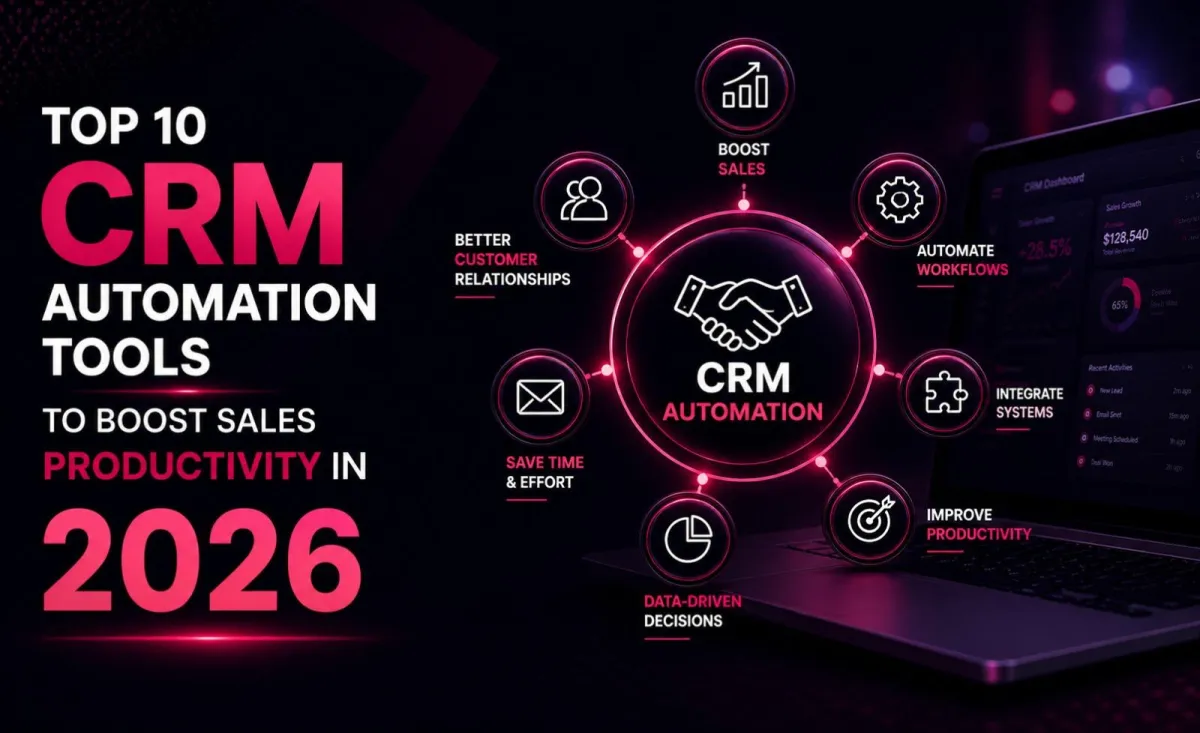
Top 10 CRM Automation Tools to Boost Sales Productivity in 2026
Let's be honest, most sales teams spend roughly 65% of their time on administrative tasks instead of actually selling. Updating records, logging emails, scheduling follow-ups, and manually moving deals through pipelines. By 2026, that inefficiency isn't just annoying, it's a competitive death sentence.
The good news? The right CRM automation tools can flip that equation entirely. Here's what actually works this year.
What Are CRM Automation Tools?
Before diving into the top picks, let's clarify what we're actually talking about. CRM automation tools are software features or standalone platforms that automatically handle repetitive tasks within your customer relationship management system. Think of them as your digital sales assistant that never sleeps, never forgets to follow up, and doesn't complain about data entry.
A CRM system on its own is essentially a database, a place to store contacts, deals, and activities. But when you layer CRM automation on top, that database becomes intelligent. It starts triggering actions based on conditions, routing leads to the right people, updating fields automatically, and even predicting which deals are most likely to close.
So what are CRM automation tools exactly? They're the engines that turn a passive record-keeping system into an active sales machine. They handle workflow, task, and lead routing automation, as well as email sync and pipeline reporting automation. Without them, you're basically using a digital rolodex.
Related Reading: What is CRM and Why It Matters for Modern Businesses
How We Chose the Best CRM Automation Tools for 2026
This list focuses on platforms that genuinely boost sales productivity rather than adding more complexity. We looked at sales workflow automation capabilities, AI in CRM automation features, integration depth, and real-world ease of use. Whether you need CRM for a small business or enterprise CRM automation, there's something here for you.
1. HubSpot CRM Automation Tools
HubSpot continues to dominate the CRM marketing automation tools space, and for good reason. Their free tier alone offers surprisingly robust automated task creation and deal stage automation.
What makes it great for sales productivity:
AI lead scoring that automatically prioritizes hot prospects
Email sequences automation with open and click tracking
Lead nurturing automation that adapts based on behavior
Seamless CRM with Gmail integration and Outlook
HubSpot's workflow automation builder uses a simple "if this, then that" logic. When a lead fills out a form, automatically assign them to the right rep, create a follow-up task, and enroll them in a nurture sequence. It's one of the best CRM automation tools 2026 for teams already using the HubSpot ecosystem.
Best for: SMBs and mid-market sales teams that need marketing and sales alignment.
Related Reading: Types of CRM Systems (Operational, Analytical, Collaborative)
2. Salesforce CRM Automation
Salesforce remains the gold standard for enterprise CRM automation. Its pipeline automation capabilities are unmatched, though the learning curve is real.
Key automation features:
Sales forecasting automation powered by Einstein AI
Pipeline reporting automation with customizable dashboards
AI sales forecasting that improves accuracy over time
Cross-platform automation via Flow Builder and Process Builder
Where Salesforce shines is CRM data automation at scale. You can build complex CRM workflow triggers that span across departments. For example, when a deal reaches a certain stage, automatically trigger a quote generation, notify the fulfillment team via CRM with Slack integration, and update inventory projections.
Best for: Enterprise teams and companies with complex sales pipeline management needs.
3. ActiveCampaign CRM Automation
ActiveCampaign started as an email marketing platform but has evolved into a serious CRM automation software contender. If email marketing automation and behavioral automation are your priorities, this is worth a hard look.
Standout capabilities:
Trigger-based email campaigns that react to site behavior
Automated CRM updates based on email engagement
CRM activity tracking that ties every interaction to a contact record
Predictive analytics CRM features for churn and lifetime value
The marketing workflow automation builder is visual and intuitive. You can set up follow-up automation that changes message frequency based on whether someone opened your last email. It's particularly strong for CRM for marketing teams that need tight alignment between campaigns and sales follow-up.
Best for: Marketing-driven companies and e-commerce brands.
Related Reading: CRM vs ERP: Key Differences Explained
4. Pipedrive Automation
Pipedrive built its reputation on visual sales pipeline management, and its automation features have caught up nicely. It's arguably the most accessible option for boosting sales productivity without a huge implementation headache.
Automation highlights:
Deal stage automation that moves deals based on activity completion
Automated follow-ups when deals stagnate
Meeting automation with native scheduling links
Task automation for post-meeting next steps
The no-code automation tools within Pipedrive let sales reps build their own workflows without IT involvement. Want to automatically create a task when an email with "proposal" in the subject line arrives? Two clicks. Need to eliminate CRM admin work for your junior reps? Pipedrive makes it painless.
Best for: CRM for startups and growing sales teams that want simplicity.
5. Zoho CRM Automation
Zoho CRM often flies under the radar, but its automation engine is surprisingly deep,especially considering the price point. For SMB CRM automation, it offers enterprise-grade features without the enterprise price tag.
What you get:
Blueprints for complex business process automation CRM
Lead routing automation based on territory, product interest, or rep workload
Workflow automation with time-based triggers
CRM API integrations to connect with thousands of third-party apps
Zoho's AI in CRM automation (called Zia) can predict deal probability, suggest next steps, and even draft emails. The CRM with Outlook integration is particularly smooth for Microsoft-heavy organizations.
Best for: Budget-conscious SMBs and companies already using the Zoho ecosystem.
Related Reading: Benefits of CRM Automation Services for Business Growth
6. Monday Sales CRM Automation
Monday.com expanded into CRM a few years ago, and its automation capabilities leverage the same visual builder that made their work OS popular. If you're tired of fix messy CRM data across spreadsheets and disconnected tools, this helps.
Automation strengths:
Visual workflow automation that anyone can build
Automate follow-ups based on timeline triggers
CRM data automation that pulls from forms and emails
Cross-platform automation with 200+ native integrations
Monday Sales excels at reducing manual data entry CRM scenarios. You can build automations that create new deals when a lead reaches a certain score, update fields when an email is opened, or send Slack notifications when a deal moves to "contract sent."
Best for: Teams that want unified project management and CRM in one place.
7. Freshsales Automation
Freshsales (part of the Freshworks suite) offers built-in AI-powered CRM tools that feel surprisingly premium for their mid-market price point. Their AI lead scoring uses 360-degree behavioral data, not just demographic firmographics.
Key automation features:
Workflow automation with multi-step conditionals
AI meeting summaries that auto-log call notes
Email sequences automation with A/B testing
Pipeline automation that enforces next steps
The automated task creation engine is particularly smart; it analyzes past winning deals to suggest optimal follow-up timing. Freshsales also includes built-in phone and chat, with CRM activity tracking that logs everything automatically.
Best for: Mid-market sales teams that need an all-in-one solution without Salesforce complexity.
8. Keap Automation
Formerly Infusionsoft, Keap was built from day one for small business owners who aren't CRM experts. It's less flashy than some competitors but brutally effective at automating follow-ups and reducing manual data entry.
What works:
Lead nurturing automation campaigns with tagging
Automated CRM updates from appointment bookings
CRM efficiency tools focused on client management
Task automation for invoice follow-ups
Keap's superpower is customer data automation for service-based businesses. When a client books a consultation, automatically send a confirmation, add a calendar block, create a pre-call task for the rep, and schedule a follow-up email for after the meeting.
Best for: Service businesses, consultants, and agencies.
9. ActiveCampaign (Already covered above)
See #3 – ActiveCampaign earns its spot as both a marketing and sales automation
10. Cirrus Insight Automation
Cirrus Insight takes a different approach. Instead of replacing your existing CRM system, it adds CRM automation directly inside Gmail and Outlook. For teams that live in their inbox, this is a game-changer.
Standout features:
CRM with Gmail integration that auto-syncs emails to contact records
CRM with Outlook integration for Microsoft shops
Email sync automation that eliminates manual logging
Automated task creation from emails
Cirrus Insight solves one of the biggest CRM data accuracy problems: reps forgetting to log emails. Every email you send or receive automatically attaches to the right contact, account, and deal. It also offers meeting automation that schedules from your inbox and logs everything.
Best for: Teams that rely heavily on email as their primary sales channel and want to eliminate CRM admin work without switching platforms.
How CRM Automation Actually Boosts Sales Productivity
You've seen the tools. But how CRM automation works in practice might still feel abstract. Let me break down the real-world impact:
Before automation: A lead downloads a whitepaper. A rep manually copies their info into the CRM system, assigns a follow-up task, sends a generic email, and hopes they remember to check back in three days. If another rep reaches out first? Confusion. If the lead goes cold? No one notices until it's too late.
After automation: That same lead download triggers a lead routing automation workflow. The CRM automation software checks territory rules, assigns the lead to the right rep, sends a personalized email sequence automation over five days, creates a task for day three, and updates the deal stage automatically. If the lead clicks a link, the rep gets a Slack notification. If the lead goes inactive, they're moved to a nurture track.
The result isn't just an increase in sales efficiency, it's a fundamentally better customer experience. Prospects get faster responses, more relevant follow-ups, and fewer "who are you again?" moments.
How to Choose the Right CRM Automation Tool for 2026
With so many best CRM automation tools 2026 options, how do you pick? Here's my framework:
Start with your worst manual task. What single activity eats the most sales time? Logging emails? Scheduling follow-ups? Updating deal stages? The CRM automation tools that solve your biggest pain point first will deliver the fastest ROI.
Then consider your tech stack. If you live in Gmail, prioritize CRM with Gmail integration. If you use Slack for internal communication, find tools with CRM with Slack integration. The best CRM automation software works with your workflow, not against it.
Finally, think about scale. The CRM for a small business that works for three reps might choke at thirty. Look for platforms with CRM API integrations and no-code automation tools that grow with you. And always, always test CRM data accuracy before trusting automations with customer relationships.
Final Thoughts
By 2026, why CRM automation is important won't even be a question; it'll be table stakes. The real question is whether you're using automated CRM workflows to boost sales productivity or just adding another tool to a messy stack.
Start small. Automate one workflow this week. Maybe it's lead routing automation for inbound requests. Maybe it's email sync automation, so reps stop forgetting to log conversations. Whatever you pick, measure the time saved. Then reinvest that time into actual selling.
Because at the end of the day, the best CRM automation tools don't replace your sales team. They set them free to do what humans do best: build relationships, solve problems, and close deals.
Further Reading:
How to Choose a CRM Automation Tool
FAQs
Q: What are the top 10 marketing automation tools in 2026?
A: HubSpot, ActiveCampaign, Marketo Engage, Keap, Pardot (Salesforce), Mailchimp, Omnisend, Brevo (formerly Sendinblue), Drip, and Klaviyo.
Q: Can you give some CRM automation examples?
A: Auto-assigning leads to reps based on territory, sending follow-up emails when a deal stagnates, logging email conversations to contact records, updating deal stages after a meeting is completed, and triggering Slack notifications when a high-value lead opens a quote.
Q: What's a quick marketing automation tools list?
A: HubSpot, ActiveCampaign, Marketo, Keap, Mailchimp, Pardot, Omnisend, Brevo, Drip, Klaviyo, GetResponse, and Automate.io.
Q: Are there any good marketing automation tools free?
A: Yes. HubSpot's free tier includes email scheduling and forms. Brevo offers up to 300 emails/day free. Mailchimp has a free plan for basic audiences. Omnisend and Drip also have limited free versions.
Q: What does CRM automation mean in simple terms?
A: CRM automation means using software to automatically handle repetitive sales tasks, like logging emails, assigning leads, sending follow-ups, and updating deal stages, so your team spends less time on admin and more time selling.
Q: What makes HubSpot stand out for automation?
A: HubSpot offers a free CRM with visual workflow builders, AI lead scoring, email sequences, and native Gmail/Outlook sync, all without coding. It's one of the easiest platforms to start automating sales and marketing tasks.
Q: Can you list the most common CRM tools?
A: Salesforce, HubSpot, Zoho CRM, Pipedrive, Freshsales, Monday Sales CRM, ActiveCampaign, Keap, Insightly, and Microsoft Dynamics 365.
Q: Which is the best CRM with automation for most teams?
A: For small to mid-sized teams, HubSpot delivers the best balance of ease, power, and price. For the enterprise, Salesforce wins. For marketing-heavy needs, ActiveCampaign is hard to beat.
