CRM vs ERP: Key Differences & Best Choice for Business
In today’s fast-moving digital world, businesses need powerful tools to manage both customer relationships and internal operations. This is where the debate of CRM vs ERP becomes important. Many companies struggle to understand the difference between CRM and ERP systems and often choose the wrong solution, leading to inefficiencies and lost opportunities.
If you're planning to invest in business software, understanding What is CRM and Why It Matters for Modern Businesses, and how CRM-ERP integration can help you make a smarter decision that directly impacts growth, productivity, and customer satisfaction.
What is CRM and Why It Matters
Customer Relationship Management (CRM) is a system designed to manage interactions with customers and prospects. It focuses on improving sales performance, enhancing customer experience, and streamlining communication across teams.
A CRM system helps businesses track leads, manage pipelines, and automate marketing campaigns. It acts as a centralized hub for all customer-related data, making it easier to personalize interactions and close deals faster.
For businesses looking to improve engagement and conversions, the benefits of CRM-ERP often lean heavily in favor of CRM when customer growth is the primary goal. This is why investing in CRM vs ERP software at the right stage becomes crucial.
At Vivacity Solutions, integrating CRM with marketing automation tools helps businesses to manage data but turn it into actionable insights that drive revenue.
What is ERP and How It Supports Operations
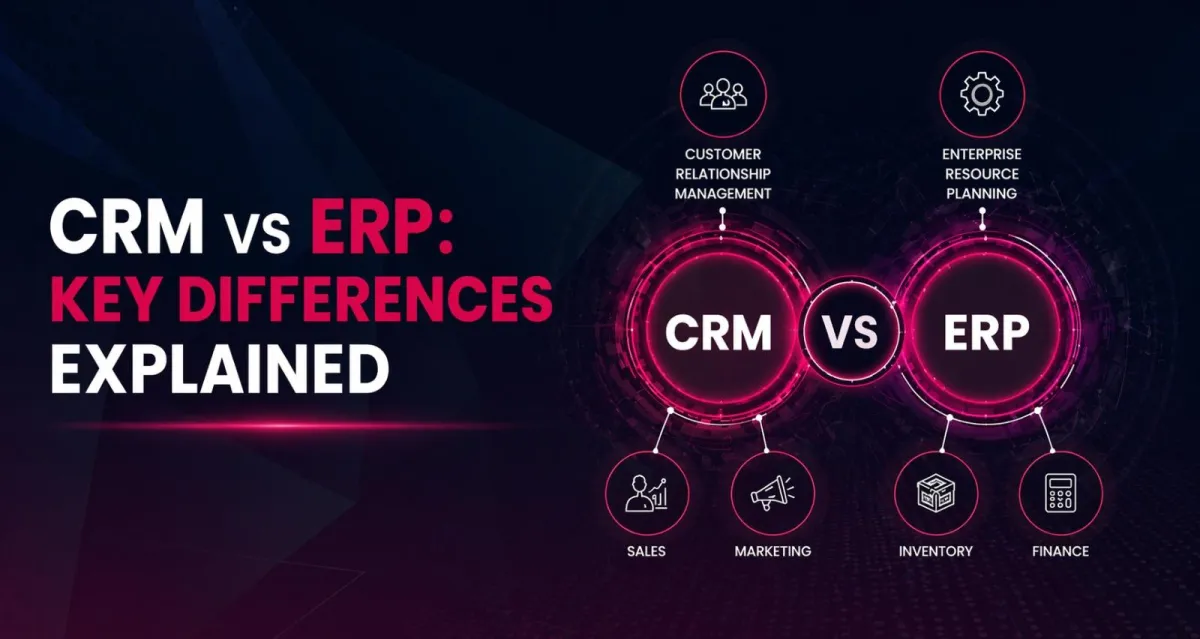
Enterprise Resource Planning (ERP) focuses on managing internal business processes such as finance, inventory, HR, and supply chain. Unlike CRM, ERP is not customer-facing; it is designed to improve operational efficiency.
ERP systems integrate different departments into one unified platform, ensuring smooth data flow and better decision-making. Businesses that deal with complex operations often rely on ERP to maintain control and reduce manual work.
When analyzing CRM vs ERP features, ERP stands out for process automation and resource planning, while CRM excels in customer engagement.
CRM vs ERP Key Differences You Must Know
Understanding CRM vs ERP is essential before making any investment. While both systems manage data, they serve completely different purposes.
CRM focuses on customer data such as interactions, sales history, and communication. ERP, on the other hand, handles operational data like finances, inventory, and logistics.
Another major point of difference between CRM and ERP systems is the user base. Sales and marketing teams primarily use CRM, whereas ERP is used by finance, HR, and operations teams.
When evaluating CRM and ERP comparison, think of CRM as a growth tool and ERP as a stability tool. One drives revenue, the other ensures smooth operations.
Features and Business Benefits
Both systems offer powerful capabilities, but their benefits vary based on business needs.
CRM Features That Will Benefit Your Business, such as lead management, customer tracking, automation, and reporting. These features directly contribute to improved sales performance and customer retention. This is why many businesses prioritize CRM when exploring CRM vs ERP advantages and disadvantages.
ERP systems, meanwhile, focus on resource optimization, financial management, and operational transparency. They help reduce costs, eliminate inefficiencies, and improve overall productivity.
If your goal is business growth and customer acquisition, CRM is often the better starting point. This is especially true for companies evaluating CRM vs ERP for small businesses, where sales growth is critical.
CRM vs ERP Use Cases and Real-World Examples
To better understand CRM vs ERP use cases, consider how different businesses apply these systems.
A service-based company may rely on CRM to manage leads and client communication, while a manufacturing company uses ERP to track production and supply chain processes.
In practical CRM vs ERP examples, eCommerce businesses often use CRM for customer engagement and ERP for order management and inventory tracking.
This clearly shows that both systems are not competitors but complementary tools, depending on business needs.
ERP and CRM Integration: The Best of Both Worlds
Instead of choosing between CRM vs ERP, many growing businesses are now combining both systems. ERP and CRM integration allows seamless data sharing between customer-facing and operational processes.
For example, when a sale is made in CRM, ERP can automatically update inventory and financial records. This integration improves efficiency, reduces errors, and provides a complete view of business performance.
Businesses aiming for scalability often consider this approach when deciding when to use CRM vs ERP together.
CRM vs ERP: Which One Does Your Business Need?
Choosing between CRM vs ERP depends entirely on your business priorities.
If your focus is on increasing sales, improving customer relationships, and managing leads effectively, CRM is the right choice. On the other hand, if your business struggles with operations, inventory, or financial management, ERP becomes essential.
For startups and growing businesses, CRM is usually the first step. It directly impacts revenue and helps build a strong customer base.
If you are still unsure about CRM vs ERP, which one my business needs, expert consultation can help you make the right decision.
Why Choose Vivacity Solutions for CRM Services
At Vivacity Solutions, we specialize in delivering customized CRM solutions that align with your business goals. Our team understands that every business is unique, which is why we design different types CRM systems that are scalable, user-friendly, and result-driven.
We don’t just implement CRM, we help you transform your sales process, improve customer retention, and maximize ROI. Whether you're a startup or an enterprise, our
are built to support your growth journey.
If you're ready to move beyond spreadsheets and manual tracking, it's time to invest in a powerful CRM system.
Get Started Today
Don’t let confusion around CRM vs ERP hold your business back. The right system can unlock new opportunities, streamline operations, and drive long-term success.
Contact Vivacity Solutions today to get a free consultation and discover how our CRM services can transform your real estate business.
Conclusion
Understanding CRM vs ERP is essential for making informed business decisions. While CRM focuses on customer relationships and sales growth, ERP ensures smooth internal operations.
Both systems play a critical role, and in many cases, integrating them delivers the best results. By evaluating your business needs and goals, you can choose the right solution and set your company on the path to success.
FAQs
What is the main difference between CRM and ERP?
The main difference is that CRM focuses on customer relationships and sales, while ERP manages internal business operations like finance and supply chain.
Can a business use both CRM and ERP together?
Yes, many businesses use both systems together. ERP and CRM integration helps streamline processes and improve overall efficiency.
Which is better for small businesses, CRM or ERP?
For most small businesses, CRM is the better starting point as it helps generate leads, manage customers, and increase sales.
Is CRM part of ERP?
In some cases, CRM can be a module within an ERP system, but they are generally separate tools with different functions.
How do I choose between CRM and ERP?
It depends on your business needs. If your priority is customer growth, choose CRM. If you need operational control, go for ERP.
Why should I choose Vivacity Solutions for CRM services?
Vivacity Solutions offers customized, scalable CRM solutions designed to improve sales performance, enhance customer relationships, and drive business growth.
What is the difference between CRM vs ERP vs SCM?
CRM vs ERP vs SCM refers to three business systems:
CRM (Customer Relationship Management) manages customer interactions and sales.
ERP (Enterprise Resource Planning) manages internal operations like finance, HR, and inventory.
SCM (Supply Chain Management) handles production and product delivery.
What are some ERP and CRM examples?
Common ERP and CRM examples include:
ERP: SAP ERP, Oracle ERP Cloud
CRM: Salesforce CRM, HubSpot CRM
What is the difference between ERP vs CRM vs SAP?
ERP vs CRM vs SAP comparison:
ERP is a system type for managing business processes.
CRM focuses on customers and sales.
SAP provides ERP and CRM solutions as a vendor.
What are the best ERP and CRM software options?
Some of the best ERP and CRM software are:
ERP: Microsoft Dynamics 365, NetSuite ERP
CRM: Zoho CRM, Pipedrive
What is an ERP and CRM course?
An ERP and CRM course teaches how to use tools like ERP systems and CRM platforms for managing business operations and customer relationships.
What is ERP and CRM integration?
ERP and CRM integration connects both systems to share data (like customer orders and financial data), improving efficiency and decision-making.
What are the latest ERP CRM trends?
Current ERP CRM trends include:
AI and automation
Cloud-based systems
Real-time data analytics
Mobile CRM and ERP usage
What is CRM ERP software for a small business?
CRM ERP software small business solutions are affordable tools that combine CRM and ERP features, such as Odoo and Zoho One, helping small businesses manage operations and customers in one system.
