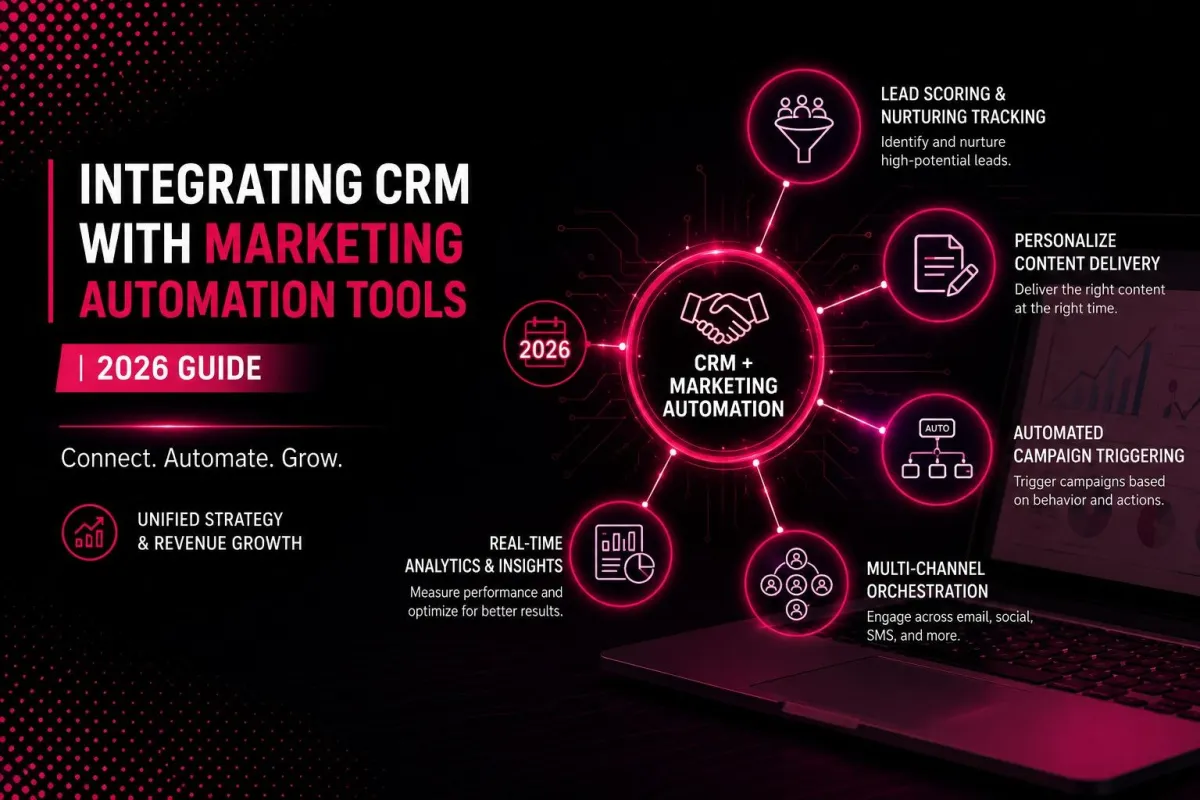
Integrating CRM with Marketing Automation Tools | 2026 Guide
Here's something most businesses learn the hard way. Your marketing team sends hundreds of beautiful emails. Your sales team makes dozens of calls. But somehow, the leads that marketing swears are "hot" feel ice-cold by the time they reach sales. Sound familiar?
The problem isn't effort. It's that your CRM and marketing automation are probably not talking to each other. When these two systems operate separately, you don't have a customer journey. You have a customer guessing game. Let me show you why connecting them changes everything.
Why Connect CRM with Marketing Automation
Before we go any further, let's answer the obvious question. Why should you bother integrating your CRM system with your marketing automation software? The short answer is that standalone tools create data silos. Your marketing team sees one version of a lead. Your sales team sees another. Neither sees the full picture. For a deeper understanding of how different CRM systems work, check out our guide on types of CRM systems.
When you connect CRM and marketing automation, suddenly, both teams work from the same reality. Every email open, every website visit, every sales call log lives in one unified CRM platform.
That means when a lead fills out a form on your website, the sales rep doesn't get a notification three days later. They get it instantly, along with that lead's entire behavioral history. This is the foundation of real sales and marketing alignment, and nothing else works without it.
According to research from HubSpot, companies that align their sales and marketing teams achieve 38% higher conversion rates and 208% higher marketing revenue. Those numbers are too big to ignore.
Not sure which CRM fits your business? Start with our beginner's guide: what is CRM before you choose a platform.
What CRM and Marketing Automation Integration Actually Looks Like
Let me paint a picture for you. Imagine a prospect visits your website, downloads a pricing guide, and then disappears for two weeks. Without integration, your marketing team might keep sending generic newsletters. Your sales team has no idea the prospect ever existed.
With proper CRM integration, that prospect's behavior triggers automated processes immediately. The marketing automation software assigns a lead score based on the download. The CRM system creates a new contact record automatically.
If the lead visits your pricing page again three days later, their lead score increases, and the CRM platform flags them for sales follow-up. By the time a sales rep reaches out, they already know what this prospect cares about. That's lead nurturing done right, and it only works when your tools are connected.
This is also how you stop wasting staff time on manual data entry. Your team stops copying and pasting and starts actually engaging with customers. The automated marketing tools handle the repetitive work while your humans handle the relationships. If you want to explore specific tools that make this easy, read our post on CRM automation tools.
Want to automate more than just lead flow? Explore CRM automation tools to see how workflow automation can transform your entire sales process.
How Marketing Automation Improves Lead Management Inside Your CRM
Most businesses think they have lead management under control. Then they check their CRM and find hundreds of leads that never got a single follow-up. Marketing automation fixes this because it doesn't rely on human memory or discipline.
Here's how it works. When a new lead enters your CRM system, your marketing automation software can automatically enroll them in a lead nurturing sequence based on who they are and what they downloaded. A CEO gets a different series of messages than a marketing coordinator.
A lead from an enterprise company gets different content than a small business owner. That's customer segmentation happening in real time, without anyone building manual lists.
Over time, CRM data analysis reveals which marketing campaigns actually produce high-value customers. You stop guessing whether that Facebook ad is working. You know exactly which channels drive customer acquisition and which ones just burn budget. This is campaign attribution at its most honest, and it transforms how you spend your marketing dollars.
CRM and marketing automation also fix one of the most frustrating problems in business: leads falling through the cracks. When a lead engages with a specific piece of content, say, a case study about your enterprise solution, the CRM system updates instantly.
Sales sees that engagement and knows exactly what to talk about on the next call. No more "just following up to see if you're interested." That's dead. Now you have real context. To understand what features enable this kind of tracking, check out our CRM Features guide.
Personalized Customer Journeys with CRM and Marketing Automation
Personalized customer journeys sound great in theory, but most businesses struggle to deliver them. The reason is simple: personalization requires data, and data requires integration. When your CRM platform feeds behavioral data directly into your marketing automation software, you can build tailored customer journeys that adapt in real time.
Think about purchasing behavior. If a customer buys a specific product, your CRM and marketing automation integration can automatically remove them from all email sequences promoting that product. Instead, they move into a cross-sell sequence for complementary products. That's not just good marketing. That's good customer experience. And it directly increases customer lifetime value (CLTV) while improving customer retention.
This same logic applies to repeat customers versus one-time buyers. Your CRM system tracks purchase frequency. Your marketing automation adjusts messaging accordingly. A repeat customer gets loyalty offers. A one-time buyer gets education about product value.
Someone who hasn't purchased in six months moves into a customer retention campaign. Every communication feels relevant because it is relevant. That's the difference between spam and genuine customer engagement.
CRM data analysis also helps you build lookalike audiences for acquisition campaigns. By analyzing your best customers inside the CRM platform, your marketing automation software can target people with similar characteristics.
This dramatically improves conversion optimization because you're not shouting into the void. You're speaking to people who actually look like your existing high-value customers.
Sales and Marketing Collaboration:
Let me be direct with you. Most organizations talk about sales and marketing alignment like it's a nice-to-have. In reality, it's the difference between growing and just surviving. When your CRM and marketing automation systems are integrated, collaboration stops being a buzzword and starts being automatic.
Your marketing team can see which leads turned into customers and which went cold. That feedback loop helps them create better content, target better audiences, and stop wasting budget on channels that don't convert. Your sales team can see which marketing campaigns a lead engaged with before they ever pick up the phone. That context turns cold calls into warm conversations.
Campaign performance becomes transparent. No more fighting over whether a lead came from marketing or sales. The CRM system tracks the entire customer journey from first click to closed deal.
You know exactly which touchpoints drive customer acquisition and which ones just create noise. That's how you improve ROI tracking and justify your marketing budget to skeptical leadership. For a broader perspective on how CRM fits with other business systems, read CRM vs ERP.
The automated processes also free up your best people to do what they do best. Your marketing team stops building manual lead lists and starts creating a strategy. Your sales team stops data entry and starts selling. That's improving efficiency at a cultural level, not just a technical one.
Want to see what's next? Read our post on How Generative AI Is Transforming Modern CRM Systems to future-proof your tech stack.
Smarter Customer Prospecting Through Integration
Old-school customer prospecting meant buying a list and hoping for the best. Those days are over, and good riddance. With integrated CRM and marketing automation, prospecting becomes surgical.
Your CRM system tracks every interaction across every communication channel, email, social media, website visits, chat conversations, and phone calls. Customer behavior analysis reveals patterns you would never spot manually.
Maybe your best customers all visit your blog post about "implementation timeline" before they buy. Maybe they all attend a specific webinar. Once you know these patterns, your marketing automation can proactively move leads through the same paths.
Engagement scoring takes this even further. Instead of a simple pass/fail lead score, modern integration lets you score based on multiple behaviors. Visiting the pricing page adds points. Downloading a competitor comparison adds more.
Ignoring three emails subtracts points. When a lead hits a threshold, the CRM system automatically notifies sales. Your team reaches out at exactly the right moment, not a week too late or a month too early.
This approach also transforms audience targeting for your marketing campaigns. Instead of blasting your entire database, you can build smart segments based on customer preferences and past purchasing behavior.
People who bought product A get different messaging than people who bought product B. People who abandoned their cart get a different sequence than people who never started checkout. Every message feels personal because your CRM platform makes it personal.
Ready to implement this, but need help? Find the right partner with our guide to choosing a CRM Development Partner.
How Integration Drives Operational Efficiency
Let's talk about operational efficiency because that's where integration pays for itself. When your CRM and marketing automation tools work separately, your team spends hours every week on tasks that should be automatic. Exporting lists. Cleaning data. Uploading to email tools. Checking for duplicates. This is the definition of wasted potential.
Integration eliminates almost all of that. A lead comes in from a Facebook ad. Your marketing automation software captures their info. Your CRM system checks for duplicates. If none exist, it creates a new record. If the lead already exists, it updates their activity history. All of this happens in seconds, without a human touching anything.
This streamline processes benefit extends to every department. Your finance team sees revenue data flow automatically from closed deals. Your customer support team sees marketing communications before talking to a customer. Your product team gets behavioral data that informs roadmap decisions. Integration doesn't just connect two tools. It connects your entire business.
According to a study by Forrester, companies that integrate their CRM and marketing automation see a 25% reduction in operational costs related to data management. That's money you can reinvest into growth.
Marketing Automation for Customer Retention and Lifetime Value
Most businesses obsess over customer acquisition while ignoring the goldmine sitting in their existing customer base. That's a mistake. Increasing customer retention by just 5% can boost profits by 25% to 95%, depending on your industry. Integrated CRM and marketing automation make retention scalable.
Here's how. Your CRM system tracks usage patterns, support tickets, and renewal dates. Your marketing automation software triggers personalized messaging based on this data. A customer who hasn't logged in for 30 days gets a "we miss you" email with tutorial links. A customer whose support ticket was resolved gets a satisfaction survey. A customer approaching renewal gets a case study showing results from similar companies.
Customer lifetime value (CLTV) improves because you're actively managing the relationship after the sale, not just hoping they stick around. Repeat customers become your best growth engine. They buy more, they cost less to serve, and they refer other high-value customers without you asking.
The integration also enables behavioral analysis of churn risk. When you see the warning signs, decreased logins, ignored emails, and negative support interactions, your automated processes can trigger retention campaigns before the customer leaves. Sometimes, a simple check-in call or a personalized discount is all it takes to keep a valuable relationship intact.
Customer engagement isn't a one-time event. It's a continuous process of delivering value across the entire customer journey. Your CRM and marketing automation integration gives you the tools to do that at scale without feeling robotic.
Curious how CRM compares to other business systems? Read CRM vs ERP to understand which one your business actually needs.
Streamline Lead Management and Optimize Staff Time
Let's talk about the practical, everyday benefits because that's what actually matters to your team. Integrated CRM and marketing automation help you streamline lead management from first touch to closed deal. Every lead follows the same rules. No one falls through the cracks. No one gets followed up with ten times, while someone else gets zero.
This also helps you optimize staff time dramatically. Your sales reps don't spend mornings logging emails and updating lead statuses. Those updates happen automatically through automated marketing tools. Your marketing coordinators don't spend afternoons exporting lists and importing them into email tools. The integration handles that in seconds.
Streamline processes across both teams, so you stop doing duplicate work. One person creates a segment in the CRM system. That segment automatically syncs to the marketing automation software. One person builds an email campaign. The results automatically flow back to the CRM platform for reporting. No handoffs. No "did you remember to update the list?" No dropped balls.
Sales and marketing collaboration becomes natural because everyone sees the same data. When marketing launches a campaign, sales sees exactly which leads are engaging. When sales closes a deal, marketing sees which campaign sourced that customer. The feedback loop is instant and automatic. That's how you build a revenue engine instead of just two departments that share a building.
Conversion optimization improves because you can test, learn, and adapt faster. Run an A/B test on email subject lines inside your marketing automation software. See which version drives more meetings booked inside your CRM system. Implement the winner. Repeat. Over time, small improvements compound into massive gains in customer acquisition efficiency.
Need help setting all this up? Explore CRM Development Services to get expert guidance on integrating your CRM with marketing automation.
Common Objections and Why They Don't Hold Up
I hear the same concerns from business owners all the time. "Our CRM system is fine on its own." "Marketing automation feels too complex." "We don't have the budget for integration."
Here's the truth. Your CRM system is not fine on its own if your marketing team can't use its data to drive campaigns. Marketing automation is only as complex as you make it, and most modern tools offer pre-built integrations that take hours, not weeks. As for budget, the cost of integration is almost always less than the cost of lost leads, wasted staff time, and misaligned teams.
Data silos are expensive. They hide in your operational costs every single day. Every time someone manually moves data between systems, you're burning money. Every time a lead gets ignored because the right person didn't know they existed, you're losing revenue. Integration isn't an expense. It's an investment in operational efficiency that pays for itself faster than almost any other tech purchase you can make.
Can I Use Marketing Automation Without a CRM System?
Yes, but you will lose visibility into which leads actually become customers. Without a CRM system, your marketing automation software becomes a broadcast tool instead of a revenue driver. You can send emails and score leads, but you cannot track closed-loop attribution. You will never know which campaigns actually produced paying customers. For most businesses, that's a dealbreaker.
What's the Best CRM Platform for Marketing Automation Integration?
HubSpot offers the tightest native integration between CRM and marketing automation because both products were built by the same company. Salesforce excels for enterprise needs with Marketing Cloud, though the integration requires more setup.
ActiveCampaign is best for marketing-heavy small teams who want powerful automation without enterprise complexity. Your choice depends on budget and technical requirements. If you're unsure, start with a free trial of HubSpot and see how the integration feels.
Final Thought
CRM and marketing automation are not two separate tools that happen to live in your tech stack. They are two halves of one complete customer relationship management (CRM) strategy. One without the other leaves you blind. Together, they give you a complete view of every prospect and customer across their entire customer journey.
The businesses that figure this out will dominate their markets in 2026 and beyond. The ones that don't will keep wondering why their lead lists are messy, their follow-ups are spotty, and their teams are constantly frustrated. You get to choose which one you want to be.
Start with one integration. Connect your CRM platform to your email tool. Then add your chat. Then add your advertising platforms. Each connection makes your customer communications smarter and your team's life easier. You don't have to do everything at once. You just have to start.
Ready to take the next step? Learn how modern technology can transform your customer relationships with CRM automation services and how Generative AI Is Transforming Modern CRM Systems. And if you need a partner to guide you, find the right fit with our CRM Development Partner guide.
FAQs
What is the difference between CRM and marketing automation?
A CRM system manages existing customer relationships and tracks sales activities. Marketing automation software handles lead generation, email campaigns, and prospect nurturing. When integrated, they work as one unified system.
Why connect a CRM system with marketing automation?
Connecting them eliminates data silos, ensures both teams work from the same information, automates lead management, and enables personalized customer journeys that would be impossible to manage manually.
How does marketing automation improve lead management?
Marketing automation automatically scores leads, assigns them to the right sales reps, triggers follow-up sequences based on behavior, and updates lead status inside the CRM system without manual data entry.
Can small businesses benefit from CRM and marketing automation integration?
Absolutely. CRM integration for lead nurturing helps small teams punch above their weight by automating repetitive tasks, ensuring no lead falls through the cracks, and freeing up staff time to optimize for high-value activities.
What is lead scoring in CRM and marketing automation?
Lead scoring assigns points to leads based on their behavior (email opens, website visits, content downloads). When a lead reaches a threshold, the CRM system automatically flags them for sales follow-up.
How does integration improve customer retention?
Integration allows you to track purchasing behavior, usage patterns, and support interactions. Automated processes trigger retention campaigns when customers show signs of disengagement, improving customer lifetime value (CLTV).
Is CRM and marketing automation integration expensive?
Many modern CRM platforms and marketing automation software offer native integrations at no additional cost. For complex needs, iPaaS tools provide affordable options. The ROI from improved efficiency and higher conversion rates typically far outweighs the investment.
Can I use marketing automation without a CRM system?
Yes, but you lose closed-loop attribution. You will know who engaged with your emails, but not who actually became a customer. Most businesses find this unacceptable for serious marketing investment.
What's the best CRM platform for marketing automation integration?
HubSpot offers the tightest native integration. Salesforce is best for enterprise needs. ActiveCampaign excels for marketing-heavy small teams. Choose based on your budget and technical requirements.
How long does CRM and marketing automation integration take?
Native integrations (like HubSpot) take under an hour to configure. API-based custom integrations can take 2-4 weeks, depending on complexity. iPaaS tools like Zapier fall in the middle, usually 1-3 days.
Your Success Starts With Vivacity Solutions. Explore Our Services.
