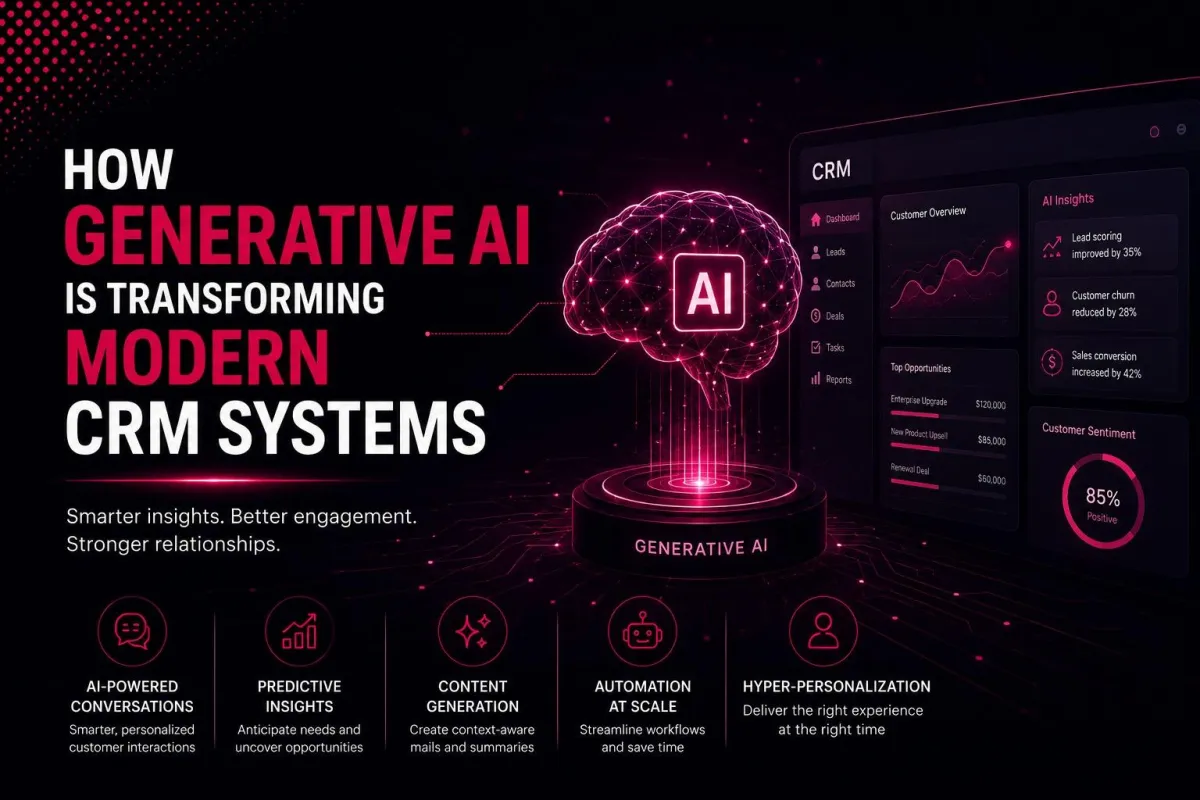
How Generative AI Is Transforming Modern CRM Systems
I still remember the first time I saw a generative AI feature inside a CRM. It was subtle, an auto‑generated email draft that sounded exactly like our top sales rep. No generic “Dear customer” nonsense. It knew the prospect’s industry, past interactions, and even their likely objections. My first thought was, “This changes everything.” And honestly, it does.
Generative AI in CRM is no longer a futuristic concept. It’s here, it’s practical, and it’s quietly reshaping how businesses manage customer relationships. From writing follow‑up emails to summarizing endless support tickets, generative AI is turning clunky CRM automation into something that feels almost human.
In this post, I’ll walk you through what Generative AI in CRM actually looks like on the ground, where it helps most, and how to decide if an AI-powered CRM is right for your team. No hype. Just real talk from someone who’s watched this space evolve.
What Is Generative AI in CRM?
Let’s start simple. Traditional CRM automation follows rules you write. “If a lead fills out a form, send a welcome email.” That’s useful but rigid. Generative AI in CRM goes further. It uses Large Language Models (LLMs) and AI agents to create new content, emails, summaries, chat responses, and even sales scripts based on your unique customer data.
So instead of templated nonsense, you get AI-generated sales emails that adapt to each lead. You get automated meeting summaries that actually capture action items. You get AI-powered chatbots that don’t just parrot FAQs but have real conversational AI skills. That’s the shift.
The best Generative AI CRM solutions learn from your team’s behaviour. They don’t replace your people; they make them faster and more consistent.
Thinking about building your own AI‑powered system? Our guide on Custom CRM Development walks you through the first steps.
Why Now? The Perfect Storm of AI and CRM
CRM systems have been around for decades, but until recently, they were mostly passive databases. You typed things in. You ran reports. You set up basic workflow automation. Then generative AI arrived, and suddenly CRMs became active participants.
There are a few reasons why Generative AI in CRM is exploding right now:
LLMs are cheap and accessible. You don’t need a PhD to integrate OpenAI’s API into your CRM platform.
Cloud-based CRM infrastructure (AWS, Azure, Google Cloud) makes it easy to scale AI workloads.
CRM APIs have matured, allowing AI to read and write data across your entire stack.
Businesses are tired of manual data entry. AI can now listen to sales calls, extract insights, and log them automatically.
If you’re still using an old‑school CRM system without AI features, you’re leaving a lot of efficiency on the table.
Key Ways Generative AI Is Transforming CRM Today
Let me give you concrete examples. Not theory, things you can actually use right now.
1. AI‑Generated Sales Emails That Actually Convert
Your sales team spends hours writing follow‑ups. Generative AI in CRM can draft personalized emails based on the prospect’s industry, past conversations, and even their tone. The AI sales automation tools inside modern CRMs like Salesforce Einstein or HubSpot’s AI features let reps review, tweak, and send in seconds.
One study I saw showed that AI-generated sales emails had a 30% higher response rate because they felt more tailored. Your mileage may vary, but the time saved alone is huge.
2. Automated Meeting Summaries and Next Steps
After every sales call or support meeting, someone has to write notes, assign tasks, and update the CRM deal forecasting fields. With Generative AI in CRM, the system listens (with permission), transcribes the call, and automatically creates a summary, action items, and even updates the sales pipeline. No more “I’ll update that later” excuses.
3. Conversational AI for Customer Support
Conversational AI CRM tools can now handle complex support tickets, not just simple FAQs. A customer writes, “My invoice is wrong, and I need a refund for order #1234.” The AI-powered chatbot understands the intent, looks up the order, checks refund eligibility, and either resolves it or passes it to a human with a full summary. AI customer support like this cuts response times from hours to seconds.
4. Predictive Analytics Meet Generative Insights
Traditional predictive CRM analytics tells you what might happen: “This lead has a 70% chance to close.” Generative AI in CRM tells you why and what to do. It might say, “This lead hasn’t opened your last three emails. Try sending a case study about their industry.” That’s AI-driven customer engagement that’s actually helpful.
5. Personalized Marketing at Scale
Generative AI CRM solutions can produce hundreds of unique email variations, landing page headlines, or even social media posts, each tailored to a specific segment. Personalized marketing becomes automated but still human‑sounding. I’ve seen marketing automation campaigns that used Generative AI in CRM to boost open rates by 25% simply because the subject lines didn’t feel like spam.
Of course, AI isn’t magic. Many teams still face the Common Challenges in CRM automation. Here’s how to avoid them.
Real‑World Use Cases by Industry
Generative AI isn’t one‑size‑fits‑all. Different industries get different benefits.
Real estate CRM automation, AI generates property descriptions, schedules showings based on buyer preferences, and drafts follow‑up emails after tours.
Healthcare CRM AI solutions automate appointment reminders, generate after‑visit summaries, and help with HIPAA‑compliant patient communication.
Banking CRM automation, AI drafts personalized financial advice, flags unusual transactions in plain English, and helps with customer onboarding.
EdTech CRM solutions generate course recommendations, automate progress reports for students, and create engagement emails based on learning behaviour.
SaaS CRM automation, AI writes product update emails, churn prevention messages, and even generates help articles from support tickets.
AI CRM for the finance industry summarizes client portfolios, drafts investment reports, and automates compliance‑friendly communications.
No matter your vertical, Generative AI in CRM is becoming a competitive necessity.
What to Look for in an AI‑Powered CRM System
Not all AI CRM software is created equal. Here’s what I tell businesses when they ask how to evaluate.
True Integration, Not a Bolt‑On
Some vendors slap an AI label on basic automation. You want CRM with AI integration that feels native. The AI should see your customer data, your CRM workflows, and your sales pipeline without you having to copy‑paste between tools.
Customization for Your Business
Off‑the‑shelf AI might not understand your specific products or terminology. That’s where Custom CRM development comes in. A Custom AI CRM development company can train models on your own sales calls, support tickets, and product descriptions. The results are dramatically better.
Data Privacy and Security
Generative AI in CRM needs data to learn. That means you need to trust your vendor with customer information. Look for CRM security and compliance certifications like SOC 2, GDPR readiness, and HIPAA compliance if you’re in healthcare. Also, ask how your data is used; is it training their public models or kept private?
Scalable AI Infrastructure
AI models can be expensive to run at scale. Make sure your AI-powered CRM can handle your volume without slowing down or costing a fortune. Cloud-based CRM platforms with pay‑as‑you‑go AI pricing are usually the safest bet.
Choosing the right foundation matters. Understand the Types of CRM Systems before adding AI.
The Human Side: Will AI Replace CRM Users?
I get asked this constantly. The short answer is no, not even close.
Generative AI in CRM is a co‑pilot, not a replacement. It handles the repetitive, time‑consuming tasks that make your sales and support teams miserable. It writes the first draft. It summarizes the call. It suggests the next step. But humans still make the final decisions, build relationships, and handle complex emotions.
In fact, AI-powered CRM often makes human work more valuable. When your team isn’t buried in data entry, they can focus on listening, problem‑solving, and building trust. That’s a win.
The Best CRM Automation Tools with Generative AI
If you’re not building custom, there are excellent CRM automation tools on the market with built‑in generative AI. Here are a few I’ve seen work well:
Salesforce Einstein GPT writes emails, generates knowledge articles, and creates personalized content.
HubSpot’s AI tools, Email generation, chat summaries, and content assistant.
Zoho CRM with Zia, an AI sales assistant that predicts, suggests, and automates.
Microsoft Dynamics 365 Copilot, Deep integration with Office and Large Language Models.
For companies with truly unique needs, CRM development services that specialize in Generative AI CRM solutions can build something tailored exactly to your workflows.
Want a deeper dive? Here’s our roundup of the best CRM automation tools for different business sizes.
Benefits of AI‑Powered CRM Automation Services
Let’s get specific about the Benefits of AI-Powered CRM systems:
Faster response times, AI drafts replies in seconds.
Higher conversion rates, AI-based lead scoring and AI sales automation prioritize the right deals.
Lower support costs, AI customer support handles 30‑50% of tickets without human involvement.
Better forecasting, Predictive sales forecasting and revenue forecasting tools give you confidence.
Consistent customer experience, AI ensures no lead falls through the cracks.
These aren’t futuristic promises. They’re happening today in thousands of businesses.
Challenges and How to Overcome Them
Of course, Generative AI in CRM isn’t all rainbows. There are real challenges:
Data quality, AI is garbage‑in, garbage‑out. You need clean, structured customer data first.
User adoption: Your team has to trust the AI. Train them, show them the time savings.
Cost, AI API calls add up. Monitor usage.
Bias and hallucinations, LLMs sometimes make things up. Always have a human review for critical tasks.
The solution? Start small. Pilot Generative AI in CRM on one workflow, maybe AI-generated sales emails or automated meeting summaries. Learn, adjust, then expand.
Still worried about implementation? Our CRM Development Services page explains how we handle AI integration step by step.
The Future: Where Generative AI in CRM Is Headed
Looking ahead to 2026 and beyond, here’s what I’m excited about:
Context‑aware automation, AI that understands not just what you said, but what you meant across a whole conversation thread.
AI agents that take action. Instead of suggesting an email, the AI will send it (with your approval).
Real‑time personalization, CRM dashboards that change based on what the AI predicts you need to see next.
Generative AI for CRM dashboards, AI creates custom reports and visualizations on the fly from natural language queries.
We’re still early. But the trajectory is clear: Generative AI in CRM will become as standard as contact management is today.
How to Get Started with Generative AI in CRM
If you’re ready to explore, here’s a simple roadmap:
Audit your current CRM, what repetitive tasks eat the most time? Start there.
Clean your data; AI is useless with messy data.
Test an AI feature. Try the email generation or chat summary tool in your existing CRM.
Measure, Track time saved, response rates, and user happiness.
Scale, add more AI workflows or consider Custom CRM development for advanced needs.
And if you need a partner who understands both CRM and AI, that’s where a CRM Development Partner with AI expertise becomes invaluable.
Looking for a CRM Development Partner who can add generative AI to your system? Let’s talk about your project.
Final Thought
I’ve been in enough tech hype cycles to be skeptical. But Generative AI in CRM is different. It solves a real, painful problem: too much manual work, not enough time for customers. The tools are mature enough to help today, not in some far‑off future.
You don’t need to rip out your current CRM system. You can start small. Test one feature. See if your team smiles when they save two hours a week. Chances are, they will.
The goal isn’t to have the smartest AI. It’s to have happier customers and less burnout for your team. Generative AI in CRM can help with both.
Go give it a try. Your future self will thank you.
FAQs
What is generative AI in CRM?
Generative AI in CRM uses large language models to create new content, emails, summaries, and chat replies based on your customer data, automating tasks that used to require human writing.
How does generative AI improve CRM automation?
It moves from rigid rule‑based automation to intelligent, context‑aware automation. For example, AI writes personalized follow‑ups instead of sending the same template to everyone.
Is generative AI in CRM secure?
It can be, if you choose vendors with strong data privacy practices, on‑premise options, or custom models that don’t send data to public LLMs. Always review security and compliance.
Can I add generative AI to my existing CRM?
Yes, many CRM platforms now offer AI add‑ons. Alternatively, a Custom CRM development project can integrate LLMs via APIs directly into your system.
What industries benefit most from generative AI in CRM?
Real estate, healthcare, banking, SaaS, edTech, and finance all see strong benefits, but any business with high‑volume sales or support can benefit.
