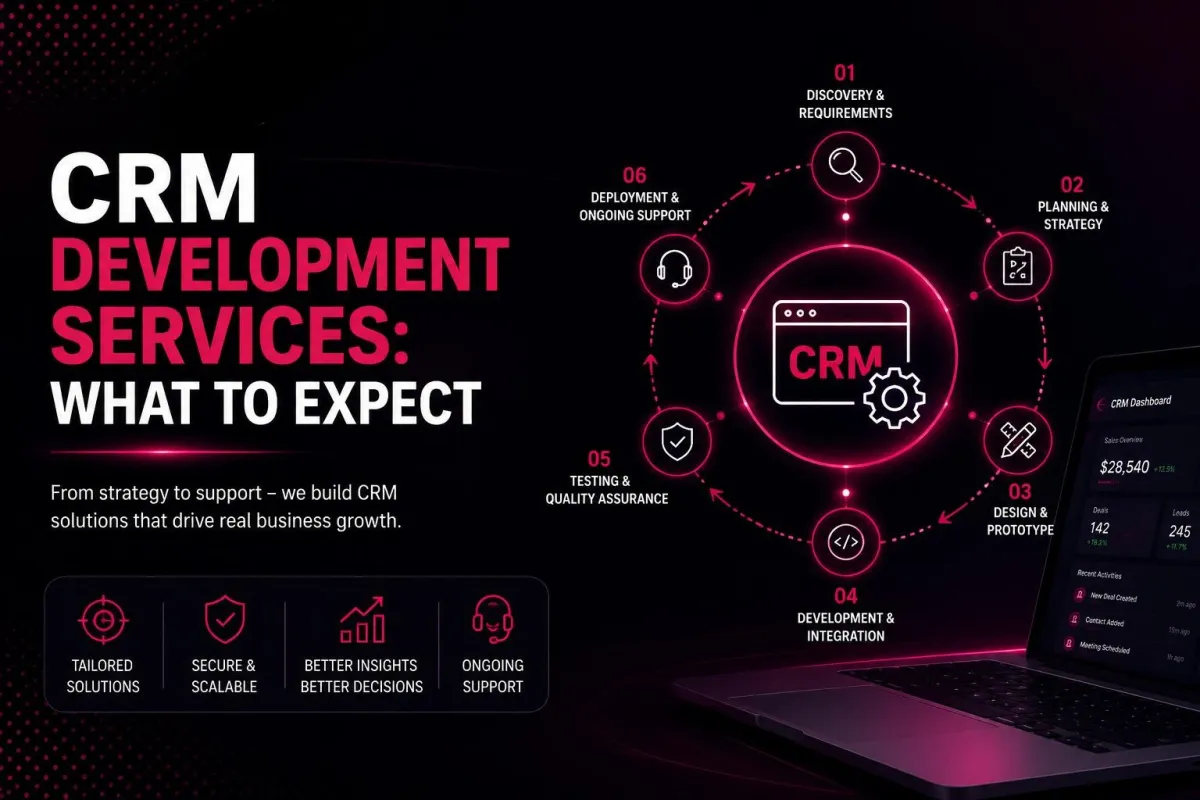
CRM Development Services: What to Expect
So you’re thinking about building a customer relationship management system from scratch, or maybe heavily customizing an existing one. First, take a breath. I’ve been there, and I know how overwhelming the options can feel. You’ve probably seen the glossy sales pages for CRM development services that promise the moon. But what do you actually get? What’s the real process like? And is it worth the investment?
Let me walk you through exactly what to expect when you hire a team for CRM development services. No fluff, no jargon, just the honest, human truth from someone who has helped businesses make this decision.
What Do We Mean by CRM Development Services?
When people say CRM development services, they’re usually talking about one of three things: building a completely custom CRM from the ground up, heavily customizing an open‑source CRM platform, or extending an existing system like Salesforce or Microsoft Dynamics with unique features.
In every case, you’re paying for CRM software development that is tailored to your business. Unlike off‑the‑shelf products, custom CRM development focuses on your specific workflows, your data, and your customers. That’s the whole point.
A good CRM system is more than just a digital rolodex. It becomes the nervous system of your sales, marketing, and support teams. With the right CRM development services, you get a tool that actually feels like it was built for you, because it was.
What to Expect in the Discovery Phase
Every solid CRM development project starts with a discovery phase. The CRM development services team will sit down (virtually or in person) with your sales managers, your support leads, and even some of your frontline reps. They’ll ask messy, uncomfortable questions like, “Why does this process take three days?” and “What information do you constantly have to look up elsewhere?”
This phase is critical. A good customer relationship management project is 70% understanding your business and 30% writing code. During discovery, the team maps out your existing CRM business processes, identifies pain points, and documents every data field you need. They’ll also talk about CRM strategy, how this new system will support your growth goals, not just your daily tasks.
You should expect to be involved. A lot. If a CRM software development company just sends you a form and disappears for two weeks, run. Real CRM development services require collaboration up front.
Designing Your Custom CRM Architecture
Once discovery is done, the team moves to CRM architecture. This is the blueprint of your system. They’ll decide on the CRM cloud infrastructure (usually Microsoft Azure, AWS, or Google Cloud Platform), the database design, and how different components talk to each other.
A modern CRM platform includes several layers: the operational component (automating sales and marketing tasks), the analytical component (reporting and predictive analytics), the collaborative component (sharing customer data across teams), and the communicative component (email, chat, phone integration). Good CRM development services will explain each piece in plain English.
You’ll also discuss CRM scalability at this stage. How many users will you have in two years? How much data will you store? A well‑built CRM system grows with you without needing to be rebuilt every 18 months.
Custom CRM Development vs. Off-the-Shelf
At some point, your CRM development services provider will ask the big question: “Should we really build from scratch, or could a customized off‑the‑shelf product work?” This is where I always pause and give my honest opinion. Custom CRM vs off‑the‑shelf CRM is not a religious debate. It’s a practical one.
If your business has truly unique workflows, think complex approval chains, industry‑specific compliance rules, or weird data relationships, then Custom CRM Development is often worth the investment. If you just want to track leads and send email sequences, an off‑the‑shelf tool with light customization might be better. A trustworthy CRM development services firm will tell you the truth, even if it means losing a project.
Not sure which path is right for you? Read our deep dive on Custom CRM Development to see real‑world examples and cost comparisons.
Development and Coding
Once you’ve agreed on the blueprint, the CRM software engineering team starts building. This typically happens in two‑week “sprints” using modern DevOps and CI/CD practices. You won’t see the code, but you will see working features every couple of weeks.
During this phase, the team builds out CRM workflows, CRM automation rules, and CRM data management structures. They’ll also implement AI in CRM features if you’ve opted for them, like predictive modeling, CRM lead scoring, sales prediction, or a CRM AI chatbot powered by conversational AI and deep language models.
You should expect regular demos. The best CRM development services invite you to click around a staging version of the system and give feedback. This is not a “come back in six months and hope for the best” situation. You are part of the process.
Integration with Everything You Already Use
A modern CRM platform never lives alone. It has to talk to your email, your calendar, your helpdesk, your ERP, your marketing automation, and maybe even your warehouse system. That’s where third‑party CRM integrations come in.
Your CRM development services team should offer CRM API integrations with tools like Outlook, Slack, Microsoft Teams, Zoom, SurveyMonkey, Typeform, and dozens of others. They’ll also handle CRM email integration, so every message is logged automatically. For larger companies, CRM ERP integration (connecting to SAP, Oracle, or Microsoft Dynamics) is often a major focus.
One thing that surprises many business owners: integration takes time. Getting two systems to sync data cleanly, without duplicates or delays, is harder than it looks. A good CRM development services provider will be upfront about the effort and test everything thoroughly.
Speaking of integration headaches, have you faced Common Challenges in CRM Automation? Here’s how to avoid them.
Data Migration and Synchronization
Unless you’re a brand‑new company, you already have customer data somewhere, spreadsheets, old CRMs, email lists, and sticky notes. Moving that data into your new CRM system is called CRM data migration, and it’s often the messiest part of the project.
Professional CRM development services include CRM data synchronization tools that clean, deduplicate, and map your old data to the new structure. They’ll also set up rules for ongoing CRM data management so your system doesn’t get dirty again.
You should expect to audit your own data before migration. No amount of software magic can fix garbage in, garbage out. But a good team will help you identify problems and fix what they can.
Security, Compliance, and Peace of Mind
If you handle sensitive customer information, credit cards, health records, or personal data from EU citizens, CRM security and CRM compliance are non‑negotiable. Reputable CRM development services are built with GDPR compliance, HIPAA compliance, and PCI DSS in mind. They also pursue certifications like ISO 27001 (information security) and ISO 9001 (quality management).
You should ask: where will my data live? Who has access? How are backups handled? What happens if there’s a breach? A good CRM software development company has clear answers and documentation.
Many businesses choose cloud CRM solutions hosted on Microsoft Azure, AWS, or Google Cloud Platform because these providers offer best‑in‑class customer data protection. Others require on‑premise CRM for regulatory reasons. Your CRM development services team should support both.
Testing, Deployment, and Go‑Live
After months of work, you’re finally ready to launch. But before that, there’s a rigorous testing phase. The team will run through hundreds of scenarios: what happens when a lead fills out a form? What if a support ticket is escalated? Does the CRM sales automation trigger correctly? Does the CRM marketing automation integration pass data both ways?
You should expect user acceptance testing (UAT) where your own team tries to break the system. This is not a formality; it’s your last chance to catch issues before real customers are affected.
Deployment can happen all at once (big bang) or in phases. Many CRM development services recommend a pilot launch with one department first, then a gradual rollout. This reduces chaos and allows for CRM training and support to happen in manageable chunks.
Speaking of successful launches, understanding the Types of CRM Systems can help you decide which strategy fits your business.
Post‑Launch: Maintenance, Support, and Evolution
Your relationship with CRM development services doesn’t end at go‑live. In fact, that’s when the real work begins. Users will find bugs. They’ll ask for features you didn’t think of. They’ll accidentally delete things. A good development partner offers ongoing CRM maintenance, CRM technical support, and regular updates.
You should expect a service‑level agreement (SLA) that defines response times for different types of issues. Critical bug? Fixed within hours. Nice‑to‑have feature? Scheduled for next month’s release.
Over time, your CRM system will evolve. You might add AI customer interactions, CRM sentiment analysis, or intelligent automation. You might integrate with new tools. A flexible CRM platform built on solid CRM architecture will let you grow without constant expensive rewrites.
Key CRM Features You’ll Actually Use
Let me highlight the CRM features that businesses consistently love after a custom build. You’ve probably seen lists before, but I’ll keep it human.
CRM lead management that automatically scores and routes leads is a game‑changer. CRM reporting tools and CRM dashboards give you real‑time visibility into your pipeline. CRM workflow automation handles follow‑ups, task assignments, and data updates without human intervention.
CRM customer engagement tools help you send the right message at the right time. CRM analytics and predictive AI forecast which deals are likely to close. CRM collaboration tools let your sales and support teams share notes without endless email threads.
CRM analytics (yes, I mentioned it twice, it’s that important) turns raw data into actionable insights. And CRM customization means you can add fields, change labels, and modify screens without calling your developer every time.
Want a deeper look at what makes a CRM powerful? Check out our guide on CRM Features That Actually Matter.
The Benefits of CRM Automation Services
Let’s be honest, you’re not buying CRM development services just to store contacts. You want automation. You want the system to do the boring work so your people can focus on selling and serving.
Benefits of CRM Automation Services include faster lead response times (no more leads sitting untouched for days), fewer manual errors (goodbye, copy‑paste mistakes), better customer experiences (because you actually remember past conversations), and higher revenue per rep (since they spend less time on data entry).
Automation also improves CRM user adoption. When salespeople see that the system automatically logs their emails and creates tasks, they stop resisting. The CRM becomes a helpful assistant, not a chore.
Combining CRM automation tools with AI in CRM takes this further: CRM lead scoring predicts which prospects are hottest. CRM sales prediction tells you your likely quarter‑end revenue. CRM customer behavior analysis spots churn risk before it happens.
I’ve seen small teams double their productivity simply by automating three or four repetitive workflows. That’s the real CRM ROI.
Curious which CRM automation tools are worth your time? Here’s our curated list.
CRM vs ERP and Other Alphabet Soup
One question that comes up constantly: “Do I need CRM or ERP?” The short answer is both, eventually. CRM vs ERP isn’t a fight; they complement each other. CRM handles front‑of‑house (sales, marketing, support). ERP handles back‑of‑house (finance, inventory, HR). CRM ERP integration connects them so your sales team can see inventory and your finance team can see open invoices.
Your CRM development services provider should understand both worlds, especially if you need Salesforce CRM, Microsoft Dynamics CRM, or SAP integration.
Red Flags to Watch Out For
Not all CRM development services are created equal. Watch for these warning signs:
They promise a fixed price without understanding your requirements.
They’ve never worked in your industry.
They don’t ask about CRM security or compliance.
They push you toward an off‑the‑shelf product when you clearly need custom CRM development.
They can’t show you examples of similar‑sized projects.
Trust your gut. Good CRM consulting services feel like a partnership, not a transaction.
Final Thoughts
Building a custom CRM is a big decision. It’s expensive. It takes time. And if done poorly, it can be a disaster. But when done right, with experienced CRM development services, clear communication, and a focus on real business needs, it’s transformative.
I’ve watched businesses go from spreadsheet chaos to a single, automated, intelligent CRM system that their teams actually love. The secret is choosing the right partner and being an active part of the process.
So if you’re ready to explore CRM development services, go in with open eyes. Expect discovery, design, coding, integration, testing, launch, and ongoing evolution. Expect to be involved. And expect to see real benefits of CRM automation services within months, not years.
FAQs
What are CRM development services?
They are professional services that build, customize, or extend CRM software for your business, including consulting, design, coding, integration, deployment, and ongoing support.
How long does custom CRM development take?
Typically 3 to 9 months, depending on complexity. A simple system might take 2, 3 months; an enterprise solution with deep integrations can take a year.
How much do CRM development services cost?
Custom projects often start around 30,000 and can go over for large enterprises. Ongoing maintenance is usually 15‑20% of the initial build cost per year.
What is the difference between CRM development services and off‑the‑shelf CRM?
Off‑the‑shelf is pre‑built software you rent monthly. Custom development builds software tailored exactly to your processes, more expensive upfront, but no per‑user fees and unlimited flexibility.
Can you integrate a custom CRM with my existing tools?
Yes. A good development team will build CRM API integrations with your email, calendar, ERP, helpdesk, marketing automation, and almost any other system.
