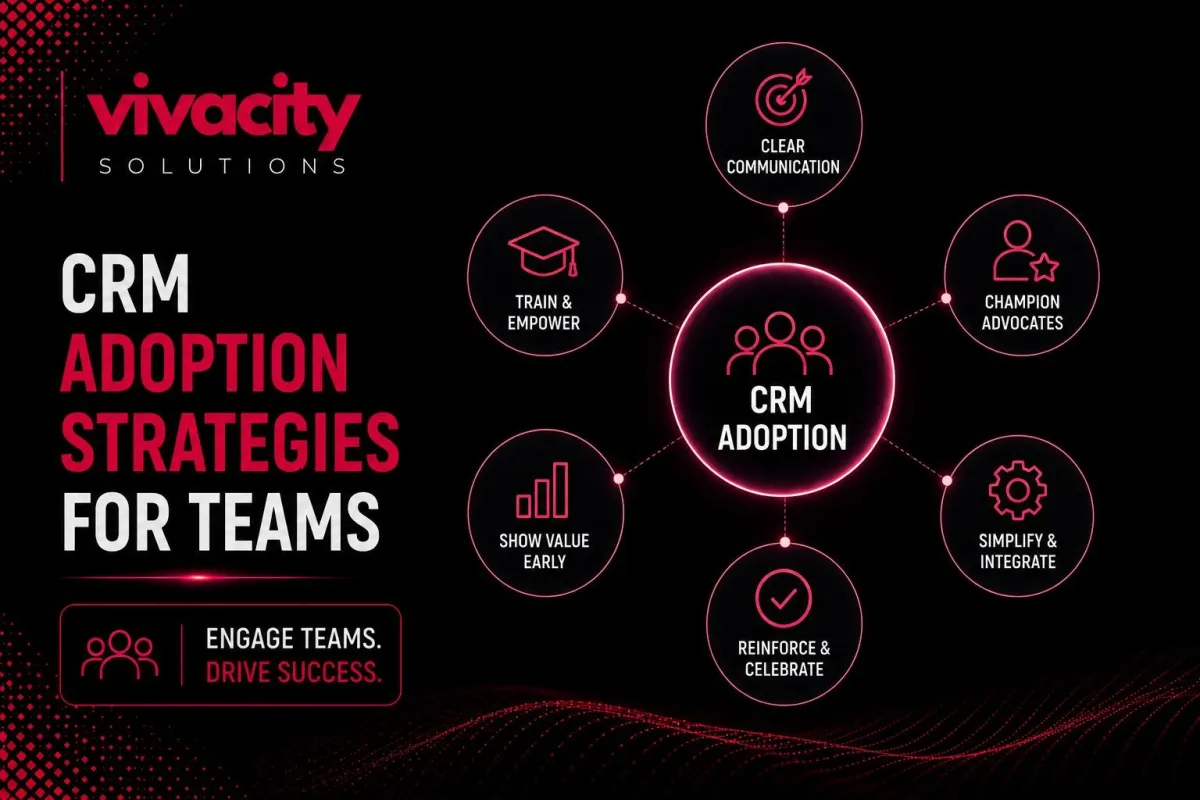
CRM Adoption Strategies for Teams | Boost User Adoption
Here is a question I get from business owners almost every week. "We bought a CRM system. We spent months implementing it. But our team refuses to use it. They keep going back to spreadsheets. What are we doing wrong?"
This is the most common CRM integration mistake encountered. The technology is installed. The data is migrated. The system is configured. But the people do not use it. And without users, your CRM software is just an expensive database.
Low user adoption is the number one reason CRM implementation fails. Studies show that up to 70% of CRM projects fail to deliver expected ROI due to poor adoption. The problem is not the technology – it is the CRM strategy for getting your team to embrace it.
What are the most effective CRM adoption strategies for teams?
Before we dive deep, let me answer this directly. The most effective CRM strategies for adoption fall into seven pillars. First, you need executive sponsorship to drive accountability. Second, you must align the CRM system with your actual sales process and sales strategy. Third, comprehensive CRM training is non‑negotiable. Fourth, you should simplify workflows to reduce friction. Fifth, gamification and incentives create motivation. Sixth, you need visible leadership and champions. Seventh, continuous feedback and optimization keep the system evolving with your team's needs.
This guide uses real‑world examples and proven techniques to help you build a CRM strategy that your team will actually want to use.
Written by Michael, CRM Strategy Lead at Vivacity Solutions. I have helped over one hundred teams achieve 90%+ CRM adoption rates through practical, people‑first strategies.
Why CRM Adoption Matters for Business Success
CRM adoption is not just about getting your team to use software. It is about achieving business outcomes. When your team embraces the CRM system, you see measurable improvements in sales performance, customer retention, and operational efficiency.
CRM adoption matters because data is only valuable when it is current and complete. Without adoption, your CRM analytics are unreliable. Sales forecasting becomes guesswork. Customer communication is fragmented. And your CRM investment becomes a sunk cost.
Companies with high CRM adoption rates achieve 28% higher customer retention and 34% better operational efficiency compared to companies with low adoption. They close deals faster, forecast more accurately, and deliver a better customer experience.
CRM adoption is also a cultural win. When your team uses the CRM system consistently, they collaborate more effectively. They have a single source of truth for customer data. They stop wasting time searching for information. Productivity improves. Frustration decreases.
If you are new to CRM fundamentals, understanding what is CRM is the first step. A strong CRM strategy that focuses on adoption is the second.
Common CRM Adoption Challenges and Barriers
Before you can implement effective CRM adoption strategies, you need to understand why teams resist.
Time and complexity. Your team is already busy. Adding a new CRM system feels like extra work, not a time‑saver. If the system is complex or slow, adoption drops.
Lack of perceived value. If your team does not see how the CRM software makes their job easier, they will not use it. They need to understand the personal benefits, not just the company benefits.
Fear of accountability. A CRM system tracks activity. Some team members fear that data will be used against them. They worry about being micromanaged.
Poor training. Most teams receive minimal training. They are shown how to log in and then left to figure it out. This leads to frustration and abandonment.
Inconsistent leadership. If managers do not use the CRM system, their teams will not either. Leadership sets the example.
Data quality issues. If the CRM system contains outdated or incomplete data, users lose trust. They revert to their own records.
Understanding these barriers is essential for building a CRM strategy that addresses real concerns.
CRM integration mistakes can also contribute to adoption problems. When the CRM does not integrate with existing tools, users have to manually move data, which creates friction.
The 7 Pillars of CRM Adoption Strategies
Let me walk you through the most effective CRM adoption strategies for teams.
Pillar 1: Executive Sponsorship and Leadership Buy‑In
Executive sponsorship is the most important factor in CRM adoption. When leadership actively uses and promotes the CRM system, the rest of the team follows.
Your executive sponsor should be someone senior who can make decisions, allocate resources, and hold teams accountable. They should communicate the importance of the CRM system regularly. They should be visible in their own use of the CRM software.
The fix. Secure executive sponsorship before you start CRM implementation. The sponsor should attend training sessions, use the system daily, and reference CRM data in meetings. They should celebrate wins and address issues quickly.
The result. When leadership leads by example, adoption rates soar. Teams understand that the CRM system is not optional; it is how the business works.
Pillar 2: Align the CRM with Your Sales Process
One of the most overlooked CRM strategy elements is process alignment. Your CRM system must mirror how your team actually sells and serves customers, not how a software vendor thinks they should.
Map your sales process before you configure the CRM system. Define your sales funnel stages. Document your lead qualification criteria. Identify your key sales metrics.
The fix. Configure your CRM platform to match your existing workflows. Do not force your team to adapt to the software. Adapt the software to your team.
The result. When the CRM system supports their natural workflow, your team will embrace it. It becomes a tool that helps them, not a burden they must endure.
CRM Features that support your sales process, like pipeline visualization, task automation, and reporting, are essential. Understanding types of CRM systems can help you choose one that fits your sales process.
Pillar 3: Comprehensive CRM Training
Training is the most obvious CRM adoption strategy, but it is also the most frequently underinvested. A one‑hour webinar is not enough.
CRM training should be hands‑on, role‑based, and ongoing. Sales reps need different training from customer support agents. Managers need training on CRM analytics and reporting.
The fix. Provide live, in‑person, or virtual workshops. Create quick‑reference guides. Record video tutorials. Schedule refresher training quarterly. Appoint CRM champions in each department to answer questions.
The result. When your team knows how to use the CRM tools effectively, adoption increases. Confidence grows. Frustration decreases.
How to use CRM effectively should be part of your onboarding process for new hires. Many businesses also rely on CRM automation services to reduce manual data entry, which makes adoption easier.
Pillar 4: Simplify Workflows and Reduce Friction
Complexity is the enemy of CRM adoption. If the CRM system requires too many clicks, too much data entry, or too many steps, users will avoid it.
The fix. Audit your workflows regularly. Remove unnecessary fields. Automate repetitive tasks. Simplify your sales pipeline stages. Ensure the CRM software is intuitive.
The result. When the CRM system is easy to use, adoption becomes automatic. Your team spends time selling, not fighting with software.
CRM automation tools can reduce manual work. CRM workflow automation handles repetitive tasks like data entry and follow‑up reminders.
Pillar 5: Gamification and Incentives
Gamification is a powerful CRM adoption strategy that taps into human motivation. When you make CRM usage fun and rewarding, adoption increases.
The fix. Create friendly competitions around CRM activity. Award points for logging calls, updating deal stages, or completing tasks. Offer small prizes or recognition for top users. Display leaderboards on screens in the office.
The result. Gamification turns compliance into engagement. Your team competes to use the CRM system, and adoption becomes a game rather than a chore.
Pillar 6: Visible Leadership and CRM Champions
Leadership visibility is essential for CRM adoption. When managers and executives use the CRM system consistently, teams follow.
The fix. Appoint CRM champions in each department. These are power users who are enthusiastic about the CRM software. They help colleagues, answer questions, and demonstrate best practices.
The result. Champions create a support network that reduces friction. Peer‑to‑peer support is often more effective than formal training.
Pillar 7: Continuous Feedback and Optimization
CRM adoption is not a one‑time event. It is an ongoing process. Your CRM strategy must evolve with your team and your business.
The fix. Solicit feedback regularly. What is working? What is frustrating? What features are underutilized? Use this feedback to optimize workflows, simplify processes, and improve training.
The result. When your team feels heard, they are more invested in the CRM system. Continuous improvement keeps adoption high.
CRM analytics and CRM reporting help you track adoption metrics. Monitor login frequency, data entry rates, and pipeline updates. Use this data to identify where additional training or support is needed.
How a CRM Consultant Can Drive Adoption
A CRM consultant is one of the most effective ways to drive CRM adoption. Here is why.
A CRM consultant brings proven adoption methodologies from dozens of implementations. They have seen what works and what does not. They know the common barriers and how to overcome them.
A CRM consultant helps you align your CRM strategy with your team's daily reality. They simplify workflows, design effective training programs, and create accountability structures.
A CRM consultant also provides ongoing support and optimization. They monitor adoption metrics, identify issues early, and recommend improvements.
For complex or custom needs, a CRM consultant can work alongside CRM Development Services and a CRM Development Partner. Many CRM consulting services firms offer end‑to‑end support from planning to ongoing maintenance.
Real example: A professional services firm hired a CRM consultant after their DIY implementation failed. User adoption was at 15%. The consultant simplified workflows, provided comprehensive training, and created a gamification program. Within 90 days, adoption reached 85%, and the firm started seeing real ROI from its CRM investment.
CRM Services from an experienced provider can make the difference between a CRM that collects dust and one that drives growth.
DIY vs. Working with a CRM Consultant
Many business owners wonder whether they can handle CRM adoption on their own. Let me compare the two approaches.
DIY CRM adoption relies on your internal team. This might work if you have experienced leaders and team members who understand CRM software deeply. However, most businesses lack the expertise and time to drive adoption effectively. The result is often low adoption, frustrated teams, and wasted investment.
Working with a CRM consultant brings proven adoption strategies, faster results, and higher success rates. The upfront cost is higher, but the ROI is significantly better. A CRM consultant brings experience from dozens of similar projects. They know the common pitfalls and how to avoid them.
Companies that work with a CRM consultant achieve 40‑60% higher adoption rates within 90 days compared to DIY approaches. For most businesses, the investment in CRM consulting services pays for itself through improved productivity and revenue growth.
If you are looking for CRM developers in the USA or a CRM software development company, many firms also offer CRM consulting services to help with adoption.
How to Create a CRM Strategy for Your Team
Now, let me walk you through how to create a CRM strategy that drives adoption.
Step 1: Define your adoption goals. What does success look like? Common goals include: 90% of sales reps logging activities daily, 80% of deals updated weekly, or 95% of support tickets tracked in the CRM. Make your goals specific and measurable.
Step 2: Understand your team's needs. Talk to your users. What frustrates them about current processes? What would make their jobs easier? Use this feedback to design workflows that actually help.
Step 3: Map your sales process. Document every stage of your sales funnel. Define entry and exit criteria for each stage. This becomes the blueprint for your CRM configuration.
Step 4: Choose the right CRM software. Select a CRM platform that fits your sales process and team size. Consider CRM Features like pipeline visualization, automation, and reporting.
Step 5: Configure the system for ease of use. Simplify workflows. Remove unnecessary fields. Automate repetitive tasks. Make the CRM software intuitive.
Step 6: Design comprehensive training. Create role‑based training programs. Provide hands‑on workshops. Record video tutorials. Appoint CRM champions.
Step 7: Launch with support. Roll out the CRM system with visible leadership, ongoing support, and regular check‑ins. Monitor adoption metrics and adjust as needed.
Step 8: Iterate continuously. Solicit feedback. Optimize workflows. Celebrate wins. Keep the CRM strategy evolving.
For industry‑specific needs, read CRM for service-based businesses and How a CRM can change Your Real Estate Business for tailored approaches.
Final Thought
CRM adoption is not about technology. It is about people. When your team embraces your CRM system, you achieve business success. When they resist, your CRM investment becomes a sunk cost.
The CRM adoption strategies I have outlined here work. Executive sponsorship. Process alignment. Comprehensive training. Simplified workflows. Gamification. Visible leadership. Continuous feedback.
Start with one strategy. Implement it well. Then add another. Within months, you will see adoption improve, productivity increase, and revenue grow.
If you need help, do not go it alone. A CRM consultant or CRM implementation company can accelerate your adoption and prevent costly mistakes.
Your CRM system can transform your business. But only if your team actually uses it. Invest in adoption, and you will see the ROI you expected.
For ongoing success, explore CRM Services that include consulting, implementation, training, and support. And always keep learning about CRM strategies as your business evolves.
FAQs
What are CRM adoption strategies?
CRM adoption strategies are structured approaches to getting your team to use your CRM system consistently and effectively. They include training, process alignment, leadership buy-in, gamification, and ongoing support.
Why do teams resist using CRM software?
Teams resist using CRM software because it feels like extra work, they do not see immediate benefits, they lack proper training, the system is too complex, or they fear accountability.
How can a CRM consultant help with adoption?
A CRM consultant brings proven adoption methodologies from dozens of implementations. They help simplify workflows, provide hands‑on training, create accountability structures, and align the CRM strategy with your team's daily reality.
What is a CRM strategy for team adoption?
A CRM strategy for team adoption is a comprehensive plan that includes user training, process integration, leadership support, performance metrics, and continuous feedback. It ensures the CRM system becomes a valuable tool rather than a burden.
How long does CRM adoption take?
CRM adoption typically takes 3‑6 months for a team to become proficient and build habits. However, with strong strategies and a good CRM consultant, you can see meaningful adoption within 30‑60 days.
What is the role of gamification in CRM adoption?
Gamification uses rewards, leaderboards, and friendly competition to motivate users to adopt the CRM system. It turns compliance into engagement and increases adoption rates.
How do I measure CRM adoption?
Measure CRM adoption through metrics like user login frequency, data entry rates, pipeline updates, report usage, and task completion. CRM analytics and reporting provide these insights.
What is executive sponsorship?
Executive sponsorship is when a senior leader actively supports and uses the CRM system. They allocate resources, hold teams accountable, and communicate the CRM's importance. It is the most critical factor for adoption.
What are CRM champions?
CRM champions are enthusiastic users who help colleagues, answer questions, and demonstrate best practices. They create a peer‑to‑peer support network that reduces friction and improves adoption.
How does CRM integration affect adoption?
Good CRM integration with email, calendar, and marketing tools reduces manual data entry and makes the system easier to use. Poor integration creates friction and lowers adoption.
