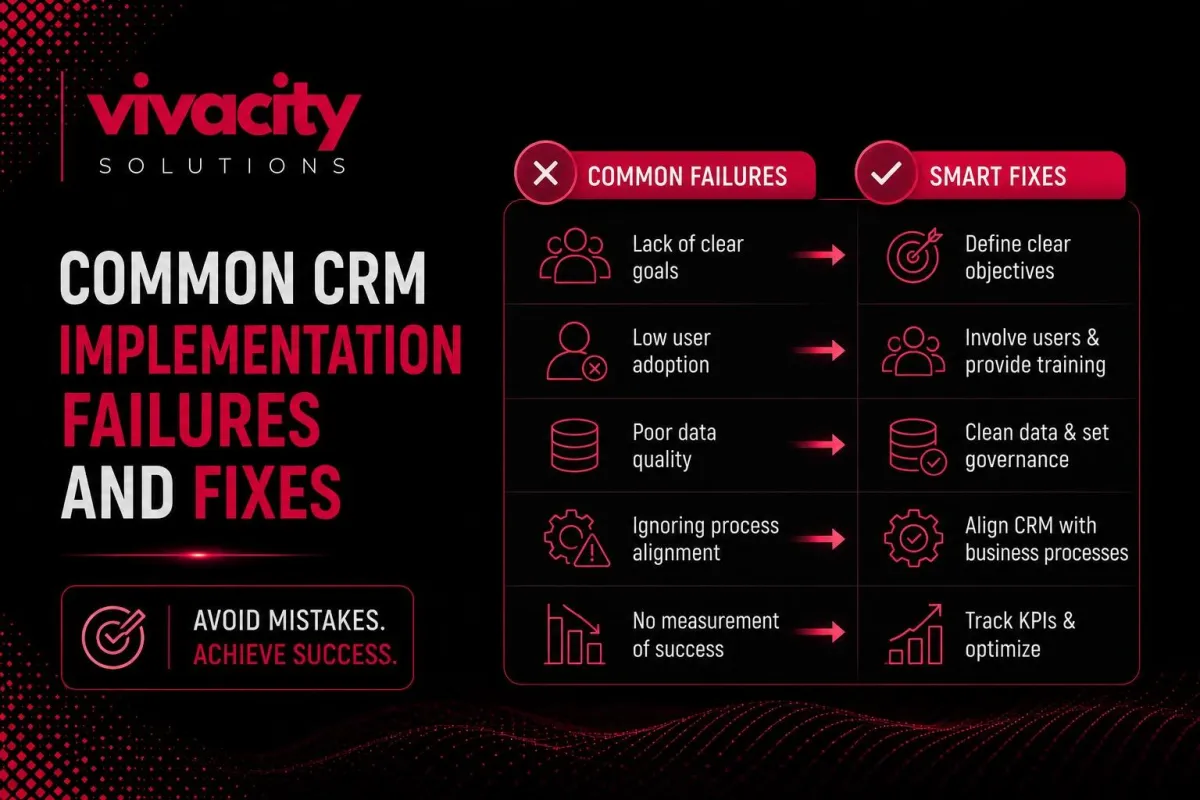
Common CRM Implementation Failures and Fixes: Guide 2026
Here is a statistic that should scare every business owner. Studies show that nearly half of all CRM implementations fail to meet their objectives. Some studies suggest failure rates as high as 63%. That means for every two companies that buy CRM software, one of them will regret it.
I have seen this pattern play out countless times. A company invests thousands of dollars in a CRM system. They spend months on CRM implementation. And then… nothing. Low user adoption. Messy data. Broken integrations. Frustrated teams. Wasted money.
The good news is that CRM implementation failures are avoidable. Most CRM integration mistakes follow predictable patterns. When you understand these CRM failure reasons, you can prevent them from happening to you.
What are the most common CRM implementation failures, and how can you fix them?
Before we dive deep, let me answer this directly. The most frequent CRM implementation failures fall into seven categories. Poor data management and data cleaning lead to garbage in, garbage out. Lack of CRM training and CRM adoption strategies means your team will not use the system. Unclear CRM goals and CRM strategy make it impossible to measure success. Over‑customization creates a system too complex to maintain. Inadequate CRM integration with other tools creates data silos. Weak executive sponsorship means no one drives accountability. Unrealistic expectations set you up for disappointment from day one.
This guide uses real‑world examples and proven solutions to help you avoid CRM implementation failures and get the ROI you deserve from your CRM investment.
Written by Michael Vivacity, CRM Strategy Lead at Vivacity Solutions. I have helped over one hundred businesses fix broken CRM implementations and build systems that actually work.
What Are CRM Implementation Failures?
CRM implementation failures are situations where a CRM system does not deliver the expected value. The CRM software might be technically installed and configured, but the business does not see improvements in sales productivity, customer retention, or operational efficiency.
These CRM failures manifest in different ways. Low user adoption is the most visible sign. Your team reverts to spreadsheets because the CRM system is too complicated or time‑consuming. Data quality deteriorates because users do not update records. Forecasts remain inaccurate because the pipeline is not maintained. And the CRM investment becomes a sunk cost rather than a growth driver.
CRM implementation mistakes are not always obvious at first. Many companies only realize they have failed six to twelve months after the initial deployment. By then, they have wasted significant time, money, and team morale.
Understanding how to avoid CRM implementation failures starts with recognizing the common patterns. Once you know what typically goes wrong, you can take proactive steps to prevent those issues.
If you are new to CRM fundamentals, understanding what is CRM is the first step. A CRM consultant can help you avoid many of these pitfalls from the start.
Why Do CRM Implementations Fail?
CRM implementation failures happen for a combination of technical and human reasons. Let me break down the root causes.
Poor planning and unclear goals. Many companies buy CRM software because they think they should, not because they have a clear CRM strategy. Without defined objectives, you cannot measure success or prioritize features.
Inadequate data management. Dirty data is the silent killer of CRM system implementation. Duplicate records, missing fields, and outdated information destroy trust in the system. Data cleaning is often skipped or rushed.
Lack of user buy‑in and training. CRM adoption is a people problem, not a technology problem. If your team does not understand the benefits or know how to use the CRM automation tools, they will not use them.
Integration failures. A standalone CRM platform is limited. The real power comes from CRM integration with email, marketing automation, ERP, and customer support. CRM integration is often harder than expected.
Over‑customization. Companies ask for too many custom features, creating a CRM system that is expensive to maintain and difficult to upgrade. This creates technical debt.
Weak executive sponsorship. Without leadership driving the CRM implementation process, there is no accountability. Teams revert to old habits.
Unrealistic expectations. Many companies expect instant results. CRM implementation takes time. Benefits build gradually as data accumulates and users become proficient.
To avoid these pitfalls, many businesses work with a CRM development company or CRM consultant who brings experience from dozens of implementations. CRM consulting services can help you plan, execute, and optimize your deployment.
The 7 Most Common CRM Implementation Failures and Their Fixes
Let me walk you through the most common CRM implementation failures and exactly how to fix each one.
Failure 1: Poor Data Management and Data Cleaning
The problem. Your existing customer data is probably a mess. Duplicate records, inconsistent formatting, missing fields, and outdated information. When you migrate this dirty data into your new CRM system, you spread the problem. Users lose trust because they cannot find accurate information.
The fix. Invest in data management and data cleaning before any CRM data migration. Deduplicate records. Standardize naming conventions (for example, "ABC Corp" not "ABC Corporation"). Fill critical missing fields. Archive old or irrelevant records. This is one of the most important CRM implementation best practices.
The result. Clean data builds trust. Users believe what they see in the CRM system. Reports are accurate. Segmentation works. Your CRM investment actually pays off.
Real example: A mid‑sized manufacturing company spent three weeks cleaning its data before migrating to a new CRM. They removed 12,000 duplicate records and standardized contact fields. Six months after implementation, user adoption was 87%, compared to an industry average of 45% for companies that skipped data cleanup.
If you need help with data management, CRM Development Services, and CRM consulting services can guide you through the process.
Failure 2: Lack of User Training and CRM Adoption
The problem. You buy a CRM system, configure it, and tell your team to start using it. Nobody does. They are comfortable with spreadsheets and email. The CRM software feels like extra work, not a time‑saver.
The fix. Invest in comprehensive CRM training. Provide live, hands‑on workshops for every user role. Sales reps need different training from customer support agents. Create quick‑reference guides and video tutorials. Appoint CRM champions in each department to answer questions.
CRM adoption is not a one‑time event. Schedule refresher training quarterly. Celebrate quick wins publicly. Show users how the CRM system makes their jobs easier, not harder.
The result. When users understand how to use the CRM tools effectively, adoption rates soar. Your team stops fighting the system and starts benefiting from it.
How to use CRM effectively should be part of your onboarding process for new hires. Many businesses also rely on CRM automation services to reduce manual data entry, which makes adoption easier.
Failure 3: Unclear Goals and CRM Strategy
The problem. You implemented a CRM system without defining what success looks like. You cannot measure ROI because you do not know what you are measuring against.
The fix. Define clear, measurable goals before you start CRM implementation. Common goals include: improve lead response time by 50%, increase sales team productivity by 20%, reduce customer churn by 15%, or centralize customer data across five departments.
Your CRM strategy should align with your overall business objectives. Document your goals, share them with your team, and track progress through CRM reporting.
The result. Clear goals give you a roadmap. You know what features to prioritize, what data to track, and how to measure success. Your CRM investment becomes a strategic asset, not a cost center.
Understanding CRM Features that support your goals is essential. CRM vs ERP can also help you decide whether you need a pure CRM or a broader business suite.
Failure 4: Over‑Customization and Technical Debt
The problem. You asked for too many custom features. Your CRM system is now so complex that it is expensive to maintain, difficult to upgrade, and confusing for users. Every change requires developer time.
The fix. Start with the core CRM platform and add customizations only where necessary. Use the vendor's standard features first. If you must customize, document everything and plan for maintenance.
Technical debt accumulates when custom code is not properly managed. Work with an experienced CRM development company or CRM developers who understand how to build scalable, maintainable solutions.
The result. A simpler CRM system is easier to use, easier to maintain, and easier to upgrade. Your team spends time selling, not fighting with software.
For businesses with unique needs, custom CRM development from a CRM software development company can be a great solution – but only if done properly with long‑term maintenance in mind.
Failure 5: Inadequate CRM Integration
The problem. Your CRM system does not talk to your email, calendar, marketing automation, ERP, or customer support tools. Your team has to manually move data between systems. Data silos persist.
The fix. Plan your CRM integration strategy before you start CRM implementation. Identify every system that needs to connect to your CRM. Evaluate integration options: native connectors, iPaaS solutions, or custom API development.
Test each integration thoroughly. Document your integration architecture. And always have error handling in place.
The result. Seamless CRM integration ensures data flows automatically between systems. Your team works from a single source of truth. Workflow automation reduces manual work.
For deeper integration, read Integrating CRM with Marketing Automation Tools, CRM-ERP Integration, and CRM integration mistakes to avoid common pitfalls.
Failure 6: Weak Executive Sponsorship
The problem. Leadership supports the CRM implementation in principle but does not actively drive it. There is no accountability. Teams do not prioritize the project.
The fix. Secure executive sponsorship before you start. The sponsor should be someone senior who can make decisions, allocate resources, and hold teams accountable. The sponsor should communicate the importance of the CRM system regularly.
The result. When leadership prioritizes the CRM implementation, the rest of the team follows. Adoption increases. Accountability improves. The project stays on track.
CRM implementation services from a CRM implementation company can also provide project management to keep things moving.
Failure 7: Unrealistic Expectations
The problem. You expect instant results. You think the CRM software will magically solve all your business problems overnight.
The fix. Set realistic expectations. CRM implementation takes time. Data accumulates gradually. Users become proficient over months. Benefits compound as the system matures.
Define milestones for the first 30, 60, and 90 days. Celebrate small wins. Build momentum gradually.
The result. Realistic expectations reduce frustration. Your team stays motivated. You see steady progress instead of disappointment.
DIY Implementation vs. Working with a CRM Implementation Company
Many business owners wonder whether they can handle CRM implementation on their own. Let me compare the two approaches.
DIY CRM implementation relies on your internal team. This might work if you have experienced IT resources and team members who understand CRM software deeply. However, most businesses lack this expertise. The result is often a system that is poorly configured, lightly adopted, and underutilized. The timeline is uncertain, the risk of errors is high, and the cost of fixing mistakes can exceed the cost of hiring help upfront.
Working with a CRM implementation company brings proven methodology, a faster timeline, reduced risk, and higher adoption. The upfront cost is higher, but the ROI is significantly better. A CRM development company or CRM consultant brings experience from dozens of similar projects. They know the common pitfalls and how to avoid them. They accelerate your timeline and reduce risk.
Companies that work with a CRM implementation company report 40‑60% faster time‑to‑value compared to DIY implementations. For most businesses, the investment in CRM implementation services pays for itself within six to twelve months.
If you are looking for CRM developers or a CRM software development company in the USA, many firms offer competitive rates without compromising quality. A CRM development company in the USA can be a cost‑effective option for custom CRM development.
How a CRM Consultant Can Prevent Implementation Failures
A CRM consultant is one of the most effective ways to prevent CRM implementation failures. Here is why.
A CRM consultant brings experience from dozens of implementations. They have seen every mistake you are about to make. They know what works and what does not. They bring proven methodologies and best practices that reduce risk.
A CRM consultant helps you define clear goals and success metrics. They ensure your CRM strategy aligns with your business objectives. They guide you through CRM software selection, CRM data migration, CRM integration, and user training.
A CRM consultant also provides ongoing support and optimization. They monitor your CRM system performance, identify issues early, and recommend improvements. They help you avoid technical debt and keep your system current.
For complex or custom needs, a CRM consultant can work alongside CRM Development Services and a CRM Development Partner. Many CRM consulting services firms offer end‑to‑end support from planning to ongoing maintenance.
Real example: A professional services firm hired a CRM consultant after their DIY implementation failed. User adoption was at 15%. The data was a mess. Integration with their billing system was broken. The consultant fixed the data issues, reconfigured the system, provided comprehensive training, and fixed the integration. Within 90 days, adoption reached 85%, and the firm started seeing real ROI from its CRM investment.
How to Choose the Right CRM Development Company
If you decide to work with a CRM development company or CRM software development company, here is how to choose the right one.
First, look for relevant industry experience. A CRM development company that has worked with businesses similar to yours understands your unique challenges and workflows. Ask for case studies and client references.
Second, evaluate their technical expertise. Do they know your CRM platform inside out? Can they handle CRM integration, CRM customization, and CRM data migration? For custom solutions, look for a custom CRM development specialist.
Third, assess their approach to change management. CRM implementation is about people as much as technology. Your CRM implementation company should have a clear plan for training, adoption, and ongoing support.
Fourth, consider their long‑term partnership model. CRM system optimization is ongoing. Choose a CRM development company that offers post‑implementation support, not just a one‑time project.
Fifth, evaluate their pricing model. Some companies charge hourly rates. Others offer fixed‑fee packages. Understand what is included and what is extra.
Sixth, assess their AI readiness. In 2026, generative AI in CRM is transforming the landscape. Your CRM development company should understand how to leverage AI for lead scoring, forecasting, and automation.
If you are looking for CRM developers in the USA, consider firms like Vivacity Solutions that offer CRM development services in the USA with competitive pricing and high quality. For industry‑specific needs, read CRM for service-based Businesses and How a CRM can change Your Real Estate Business.
Final Thought
CRM implementation failures are common, but they are not inevitable. When you understand the most common CRM mistakes, you can take proactive steps to avoid them.
Clean your data before migration. Invest in user training and adoption. Define clear goals and measure progress. Keep customization minimal and maintainable. Plan your integrations carefully. Secure executive sponsorship. And set realistic expectations.
If you do not have the internal expertise, do not go it alone. A CRM consultant or CRM development company can save you time, money, and frustration. The cost of professional CRM implementation services is almost always less than the cost of fixing a failed implementation.
Your CRM system can transform your business. But only if you implement it correctly. Learn from the mistakes of others. Follow the fixes I have outlined here. And build a CRM system that your team actually wants to use.
For ongoing success, explore CRM Services that include consulting, implementation, training, and support. And always keep learning about CRM best practices as your business evolves.
FAQs
What are the most common CRM implementation failures?
The most common CRM implementation failures include poor data migration, lack of user training, unclear goals, over‑customization, inadequate integration with other systems, and weak executive sponsorship.
Why do CRM implementations fail?
CRM implementations fail due to a combination of technical and human factors. Common reasons include poor planning, data quality issues, lack of user buy‑in, insufficient training, integration failures, and unrealistic expectations.
How can you avoid CRM implementation failures?
Avoid CRM implementation failures by cleaning your data before migration, defining clear goals, mapping your sales process, investing in user training, integrating with existing tools, and working with an experienced CRM consultant or CRM development company.
What is the role of a CRM consultant in preventing failures?
A CRM consultant brings expertise from dozens of implementations. They help you plan, choose the right platform, clean and migrate data, configure the system, train users, and provide ongoing support.
How long does a typical CRM implementation take?
A typical CRM implementation timeline ranges from 2‑4 weeks for a small business setup to 6‑12 months for complex enterprise deployments. Poor planning and data issues are the main reasons implementations are delayed.
What is CRM data migration?
CRM data migration is the process of moving customer data from legacy systems (spreadsheets, old CRMs, and email) into your new CRM software. It includes data cleansing, deduplication, field mapping, and validation.
How much does CRM implementation cost?
CRM implementation cost ranges from a few hundred dollars for DIY setup to $10,000‑$50,000 for mid‑market projects and $100,000+ for enterprise implementations with custom development.
What is the difference between CRM implementation and CRM integration?
CRM implementation is the full process of setting up and deploying a CRM system. CRM integration specifically refers to connecting the CRM with other business tools like email, marketing automation, or ERP.
Can I implement a CRM without technical skills?
Yes, many cloud‑based CRMs offer no‑code setup wizards. However, for complex customizations or integrations, technical skills or a CRM implementation partner are recommended.
What is the best CRM for my business?
The best CRM depends on your business size, industry, budget, and required features. Popular options include HubSpot (small business), Salesforce (enterprise), Zoho (mid‑market), and custom solutions from CRM development companies.
