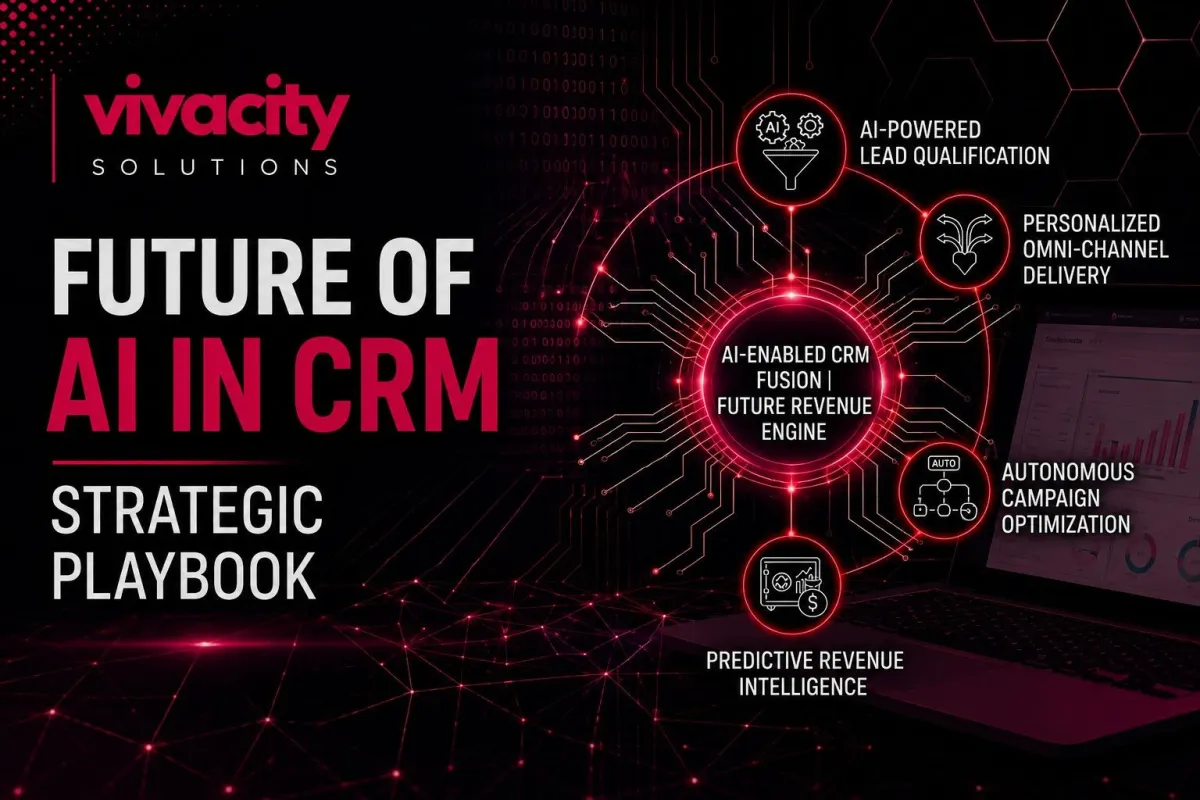
Future of AI in Customer Relationship Management
Here is something that would have sounded like science fiction five years ago. Your CRM wakes up before you do. It scans every customer interaction from the past twenty-four hours. It identifies three at-risk accounts based on subtle changes in their behavior. It drafts personalized outreach for each one. It schedules follow-up tasks for your team. And it does all of this while you are still drinking your morning coffee.
This is not a distant dream. This is the future of AI in customer relationship management, and it is arriving faster than most people realize. The question is no longer whether AI will transform CRM. The question is whether your team will be ready when it does.
What is the Future of AI in Customer Relationship Management?
Let me start with a clear picture. The future of AI in customer relationship management is not about adding chatbots to your website. That is old news. The real transformation is much deeper. We are moving from CRM systems that simply store information to AI-powered CRM systems that act on that information autonomously.
Think about how CRM works today. You enter data. You run reports. You manually trigger workflows. The system waits for you to tell it what to do. In the future of AI in customer relationship management, this dynamic flips. The CRM becomes proactive. It notices patterns you would miss. It predicts outcomes before they happen. It takes action without being asked.
This shift is powered by three converging trends. First, unified customer data is finally becoming a reality. Companies are breaking down data silos and creating complete customer views. Second, generative AI has matured from experimental to enterprise-ready. Third, agentic AI systems can now act autonomously within defined guardrails. Together, these trends are creating a future of CRM that looks very different from today.
If you are new to CRM fundamentals, take a moment to read our guide on what is CRM and explore CRM Features before diving deeper into AI.
New to CRM? Start with what is CRM and types of CRM systems to build your foundation.
How AI Is Changing CRM Systems Today
Before we look too far ahead, let me acknowledge what is already happening. AI in CRM is not a future concept. It is here now, and it is already delivering real value for companies that know how to use it.
AI-powered CRM systems today can automatically enrich contact records with data from public sources. They can score leads based on thousands of behavioral signals. They can suggest the best time to call a prospect based on past engagement patterns. They can summarize long email threads into bullet points. They can even draft personalized responses.
Take HubSpot Smart CRM as an example. It uses machine learning to predict which deals are most likely to close. It analyzes email engagement to score leads automatically. It provides conversation intelligence that helps sales reps improve their calls. This is not science fiction. This is available right now to any business willing to implement it.
But here is the important point. What we have today is just the beginning. The future of AI in customer relationship management will make today's capabilities look primitive. We are moving from AI that suggests to AI that acts. From AI that analyzes to AI that predicts. From AI that responds to AI that initiates.
Want to see what AI can do for your team today? Explore CRM automation tools and CRM automation services.
Agentic AI
Let me introduce you to the most important concept in the future of AI in customer relationship management: agentic AI.
Agentic AI refers to AI systems that can act autonomously to achieve goals. Unlike traditional AI that responds to specific commands, agentic AI understands context, makes decisions, and takes action within defined boundaries. In the context of AI in CRM, AI agents are becoming digital team members.
Here is what this looks like in practice. An AI agent monitors your unified customer data for signals that an account is at risk. It notices that a customer has stopped opening emails, stopped using the product, and has not responded to support tickets. The AI agent does not just flag this account for human review. It takes action. It drafts a retention email. It schedules a check-in call on the account manager's calendar. It escalates to leadership if the risk level crosses a second threshold. All of this happens without a human telling the AI what to do at each step.
Agentic AI represents a fundamental shift in how we think about CRM automation. Instead of building rigid "if this then that" workflows, you set goals and boundaries. The AI figures out the best path to achieve those goals. This is the future of AI in customer relationship management for go-to-market teams.
The distinction between AI copilots and AI agents matters. An AI copilot suggests. An AI agent acts. Both have their place. But the future of AI in customer relationship management belongs to agents that can execute autonomously while staying within human-defined guardrails.
For more on generative AI specifically, read How Generative AI Is Transforming Modern CRM Systems and generative AI in CRM.
AI for Sales Teams: Beyond Lead Scoring
Let me talk specifically about the future of AI in customer relationship management for sales teams. Sales has already benefited from AI through lead scoring and email automation. But what comes next is much more powerful.
Predictive lead scoring today looks at past conversion data to assign scores to new leads. That is useful, but it is static. The future of AI in customer relationship management brings dynamic scoring that updates in real time based on thousands of signals. A lead who visits your pricing page gets an immediate score bump. A lead who ignores three emails gets a score drop. A lead who mentions a competitor on a call gets flagged for competitive positioning. The scoring never stops updating.
AI-powered sales forecasting is another game-changer. Traditional forecasting relies on sales reps manually updating deal stages and probabilities. Humans are terrible at this. We are optimistic. We overestimate our chances. We forget to update records. AI-powered sales forecasting uses historical data, real-time activity signals, and machine learning to predict outcomes more accurately than any human ever could. The future of AI in customer relationship management means your forecast is no longer a guess. It is a probability distribution based on actual data.
Conversation intelligence is already transforming how sales teams coach reps. AI listens to sales calls, identifies what worked and what did not, and provides feedback. The future of AI in customer relationship management takes this further. AI will not just analyze past calls. It will provide real-time suggestions during live calls. A rep is on a call. The prospect asks about pricing. The AI whispers recommended discount ranges based on similar deals. The prospect objects to a feature. The AI provides talking points that have worked in the past. This is sales intelligence becoming a live co-pilot.
AI for sales teams also means automated CRM data management. Sales reps hate data entry. They always have. The future of AI in customer relationship management eliminates most of it. AI captures emails, logs calls, updates deal stages, and creates follow-up tasks automatically. Your sales team stops being data entry clerks and starts being relationship builders.
For a broader look at sales automation, read CRM and marketing automation, and Integrating CRM with Marketing Automation Tools.
AI for Marketing Teams
Now, let me turn to the future of AI in customer relationship management for marketing teams. Marketers have used automation for years. But most marketing automation is still rule-based and batch-oriented. The AI-powered future is different.
Customer journey personalization today usually means segmenting audiences into a handful of buckets. The future of AI in customer relationship management enables true one-to-one personalization at scale. Every customer sees different content, different offers, and different timing based on their unique behavior and preferences. AI learns what each customer responds to and adapts in real time.
Predictive segmentation replaces manual list building. Instead of a marketer defining "customers who bought product X in the last thirty days," AI creates dynamic segments automatically based on patterns it detects. It might be discovered that customers who visited the blog post about feature A, attended a webinar about use case B, and have a job title of C are your highest-value segment. The AI-driven customer insights reveal segments you never would have found manually.
AI-generated outreach is already improving email marketing. AI writes subject lines, body copy, and calls to action. But the future of AI in customer relationship management goes further. AI will generate not just emails but entire cross-channel campaigns. It will decide which channel to use for each customer. It will personalize landing pages. It will create an ad creative. It will test and optimize continuously without human intervention.
Lifecycle marketing becomes truly automated. AI monitors where each customer is in their customer lifecycle and delivers the right message at the right time. A new customer gets onboarding content. An active customer gets upsell offers. An at-risk customer gets retention campaigns. A lapsed customer gets win-back offers. The AI manages the entire customer lifecycle from acquisition to expansion to retention.
AI for marketing teams also improves campaign effectiveness measurement. Instead of last-click attribution or multi-touch attribution models that humans design, AI models learn the true causal impact of each marketing touchpoint. You stop guessing what works. You know.
Ready to integrate AI into your marketing stack? Explore CRM integration and what is crm integration for foundational knowledge
AI for Service Teams
The future of AI in customer relationship management for service teams is perhaps the most exciting of all. Most customer service today is reactive. A customer has a problem. They contact support. Support solves it. The future of AI in customer relationship management flips this model.
AI in CRM enables proactive support. The system monitors product usage, support ticket history, and customer sentiment signals. When it detects a pattern that historically leads to problems, it reaches out before the customer even knows there is an issue. "We noticed you are having trouble with feature X. Here is a tutorial video." "Your usage pattern suggests you might be approaching a known bug. Here is a workaround." The customer never has to file a ticket because the problem is solved before they notice it.
Churn prediction becomes more accurate and more actionable. AI analyzes hundreds of signals to identify accounts at risk of leaving. But the future of AI in customer relationship management goes beyond prediction. AI recommends specific interventions for each at-risk account based on what has worked for similar accounts in the past. It even automates simple retention plays.
Customer support automation handles an increasing percentage of tickets without human involvement. Simple questions get answered by AI. Routine problems get solved by AI. Humans handle only the complex, high-judgment cases. This frees your support team to focus on relationships rather than repetitive questions.
AI-driven customer insights from service interactions feed back into product and sales teams. The AI detects patterns in support tickets that indicate product issues. It surfaces feature requests from high-value customers. It identifies training gaps that cause repeated questions. The entire organization gets smarter because the service team's AI is sharing what it learns.
For more on CRM across different business functions, read CRM vs ERP and CRM-ERP Integration.
Unified Customer Data
None of the future of AI in customer relationship management works without unified customer data. AI is only as good as the data it has access to. If your customer data is scattered across disconnected systems, your AI will be scattered and disconnected too.
Unified customer data means bringing together information from your CRM, marketing automation, support desk, billing system, product analytics, and every other customer touchpoint. This data must be clean, consistent, and accessible in real time. The future of AI in customer relationship management depends on breaking down data silos that have plagued businesses for decades.
CRM data management becomes more important, not less, in an AI-powered world. AI can help clean data automatically. It can deduplicate records. It can fill missing fields. It can flag inconsistencies. But someone still needs to set up the data infrastructure and maintain data quality over time. Garbage in, garbage out remains true even with the most advanced AI.
The future of AI in customer relationship management will see the rise of customer data platforms that serve as the central nervous system for AI-powered CRM. These platforms ingest data from everywhere, clean it, unify it, and make it available to AI agents. They become the single source of truth that every AI tool draws from.
Real-time customer signals become the new raw material for AI. Every click, every email open, every support ticket, every product usage event feeds into the AI's understanding of each customer. The AI adapts instantly based on new signals. Your CRM becomes a living system that evolves with your customers.
Need help unifying your customer data? Our CRM Development Services and CRM Development Partner guides can help you build the right foundation.
Predictive Lead Scoring and Sales Forecasting
Let me go deeper into two specific applications that will define the future of AI in customer relationship management: predictive lead scoring and AI-powered sales forecasting.
Predictive lead scoring today uses basic models that look at a handful of variables. The future of AI in customer relationship management brings models that analyze hundreds or thousands of signals. These models learn which behaviors actually predict conversion for your specific business. They adapt as your business changes. They get more accurate over time.
The benefits of AI-powered CRM for lead scoring are substantial. Companies using advanced AI-powered lead scoring tools report two to three times higher conversion rates from marketing-qualified to sales-qualified leads. They waste less time on leads that will never buy. They focus attention on leads that actually have potential.
AI-powered sales forecasting addresses one of the oldest pain points in sales management. Traditional forecasts are notoriously inaccurate. Reps are overly optimistic. Deals slip. Pipeline gets stale. AI-powered sales forecasting uses machine learning to predict outcomes based on actual data, not human optimism.
Pipeline forecasting becomes more reliable when AI considers factors humans miss. The AI notices that deals from certain industries always take longer. It seems that deals with certain decision-makers close at higher rates. It detects that deals that go quiet for more than two weeks almost always die. Predictive forecasting in CRM gives you a forecast you can actually trust.
The future of AI in customer relationship management will bring forecasting that updates in real time. As soon as a deal changes status, the forecast updates. As soon as a new signal appears, the probability adjusts. Your forecast is never stale because your AI never sleeps.
For practical guidance on implementing AI in your CRM, read CRM Features and CRM automation tools.
Conversation Intelligence and AI-Generated Outreach
Conversation intelligence is one of the most practical applications of AI in CRM available today. AI listens to sales calls, customer support interactions, and even internal meetings. It analyzes what was said, how it was said, and what outcomes resulted.
The future of AI in customer relationship management brings conversation intelligence that does more than just analyze. It coaches. After a call, the AI provides feedback to the rep. "You talked for sixty percent of the call. Your top performers talk for forty percent." "You did not ask about the budget. That question correlates with a thirty percent higher close rate." "The prospect mentioned your competitor three times. Here are talking points for next time."
AI-generated outreach takes this a step further. Instead of humans writing every email, AI drafts personalized messages based on the recipient's behavior, industry, role, and past interactions. A sales rep reviews, tweaks, and sends. Or for lower-stakes outreach, the AI sends automatically.
The future of AI in customer relationship management will see AI-generated outreach become indistinguishable from human-written content. The AI learns your brand voice. It learns what works with different audience segments. It tests and optimizes continuously. Your outreach gets better every day without your team spending hours writing.
CRM personalization reaches new heights when AI generates content. Every customer receives messages tailored to their specific situation. A prospect in the awareness stage gets educational content. A prospect in the consideration stage gets case studies. A prospect in the decision stage gets pricing and demos. The AI knows where each prospect is in their journey and delivers accordingly.
For more on personalization and automation, read CRM and marketing automation and Integrating CRM with Marketing Automation Tools.
The Role of AI Agents in CRM Workflows
Let me explain AI agents in CRM because this is where the future of AI in customer relationship management gets really interesting.
AI agents are autonomous systems that can execute multi-step workflows without human intervention. Unlike traditional CRM automation that follows rigid "if this then that" rules, AI agents understand context and can adapt their approach based on what they encounter.
Here is an example. A traditional CRM workflow might say: when a lead downloads a white paper, add them to email sequence A. An AI agent approach says: when a lead downloads a white paper, figure out the best next action based on their industry, role, past behavior, and current seasonality. Sometimes that means email sequence A. Sometimes it means a sales call. Sometimes it means a different email sequence entirely. The AI agent decides.
Agentic AI systems can handle exceptions automatically. When a lead unsubscribes from emails, the AI agent updates their communication preferences across all systems. When a deal closes, the AI agent triggers the order-to-cash process. When a customer churns, the AI agent initiates the win-back workflow. Humans set the goals and boundaries. AI agents execute.
The future of AI in customer relationship management will see AI agents working alongside human teams as digital colleagues. They will handle routine tasks, flag exceptions, and escalate complex situations to humans. Your team will spend less time on process and more time on relationships.
AI agents also enable cross-team collaboration at scale. An AI agent can coordinate between sales, marketing, and service teams automatically. When a support ticket reveals a product issue, the AI agent notifies the product. When a sales call uncovers a competitive threat, the AI agent shares that intelligence with marketing. The AI agent becomes the connective tissue between functions.
Ready to implement AI agents in your CRM? Explore CRM automation services and CRM Development Partner options.
Getting Ready for the Future of AI in CRM
The future of AI in customer relationship management is coming, whether you are ready or not. Here is how to prepare your organization.
First, get your data house in order. Unified customer data is the prerequisite for everything else. Audit your current data sources. Clean your existing records. Break down data silos between departments. Invest in CRM data management processes that maintain quality over time. AI cannot fix dirty data. It can only work with what you give it.
Second, start using AI in CRM today, not tomorrow. You do not need to wait for the perfect agentic AI platform. Start with the AI features already in your CRM. Most modern AI-powered CRM systems offer predictive lead scoring, conversation intelligence, and automated data enrichment. Use these features. Learn what works. Build internal expertise.
Third, train your teams. The future of AI in customer relationship management requires new skills. Your sales reps need to know how to interpret AI recommendations. Your marketers need to understand how to set AI goals. Your service teams need to learn how to work alongside AI agents. Start training now.
Fourth, choose partners wisely. The future of AI in CRM will be built on platforms that prioritize unified customer data, agentic AI capabilities, and strong security. Evaluate your current CRM. Does it have a clear AI roadmap? If not, consider switching. Our CRM vs ERP and types of CRM systems guides can help you evaluate options.
Finally, start small and scale. Pick one workflow to automate with AI. Measure the results. Learn what works. Then expand. The future of AI in customer relationship management will be built incrementally, not overnight.
For help preparing your CRM for the AI future, read How Generative AI Is Transforming Modern CRM Systems and generative AI in CRM.
Final Thought
The future of AI in customer relationship management is not about replacing humans. It is about augmenting them. AI will handle the repetitive, data-intensive tasks that drain your team's energy. Your people will focus on what humans do best: building relationships, exercising judgment, and solving complex problems.
The companies that embrace this future will have a massive advantage. They will respond to customers faster. They will personalize at scale. They will predict churn before it happens. They will forecast accurately. Their teams will be happier because they spend less time on data entry and more time on meaningful work.
The future of AI in customer relationship management is already arriving. The question is not whether it will transform your industry. It will. The question is whether your team will be leading that transformation or scrambling to catch up.
Start today. Clean one data set. Enable one AI feature. Train one team. The future is nearer than you think.
Ready to build your AI-powered CRM strategy? Explore CRM Development Services, CRM Features, and CRM automation tools to get started. Also, check what is crm integration, CRM-ERP Integration, and our complete CRM and marketing automation guide for a fully connected tech stack.
FAQs
What is the future of AI in customer relationship management?
The future of AI in customer relationship management includes agentic AI that acts autonomously, predictive forecasting, unified customer data platforms, and AI agents that handle tasks across sales, marketing, and service teams without human intervention.
How is AI changing CRM systems?
AI is transforming CRM from passive databases into active systems that predict customer behavior, automate CRM workflows, generate personalized content, and provide real-time sales intelligence to go-to-market teams.
What is agentic AI in CRM?
Agentic AI refers to AI agents that can act autonomously within CRM systems. Unlike AI copilots that suggest actions, AI agents execute tasks like updating records, scheduling follow-ups, and responding to customer inquiries without human intervention.
What are the benefits of AI-powered CRM?
Benefits of AI-powered CRM include predictive lead scoring, AI-powered sales forecasting, conversation intelligence, customer journey personalization, automated CRM data management, and AI-driven customer insights that improve decision-making.
How does AI help sales teams in CRM?
AI for sales teams includes predictive lead scoring, automated data entry, conversation intelligence that analyzes calls, next-best-action recommendations, and pipeline forecasting that accounts for real-time customer signals.
What is HubSpot Smart CRM?
HubSpot Smart CRM is an AI-powered CRM platform that uses machine learning to deliver predictive lead scoring, automated data enrichment, conversation intelligence, and personalized customer experiences across the entire customer lifecycle.
Will AI replace CRM users?
No. AI will augment human workers, not replace them. The future of AI in customer relationship management is about handling repetitive tasks so humans can focus on relationship building, strategic thinking, and complex problem-solving.
What is predictive lead scoring?
Predictive lead scoring uses machine learning to analyze hundreds of signals and predict which leads are most likely to convert. It is more accurate than traditional rule-based scoring and updates in real time as new data arrives.
What is conversation intelligence in CRM?
Conversation intelligence uses AI to analyze sales calls and customer interactions. It identifies what worked, what did not, and provides coaching feedback to improve future conversations.
How does AI improve customer service in CRM?
AI for service teams enables proactive support, churn prediction, automated ticket resolution, and customer support automation that handles routine questions so humans can focus on complex issues.
What is unified customer data?
Unified customer data means bringing together information from your CRM, marketing automation, support desk, billing system, and every other customer touchpoint into a single, consistent view that AI can use to make predictions and take action.
How do I prepare my business for the future of AI in CRM?
Start by cleaning your data and breaking down data silos. Then start using existing AI in CRM features today. Train your teams on new skills. Choose CRM platforms with strong AI roadmaps. Start small with one workflow and scale from there.
