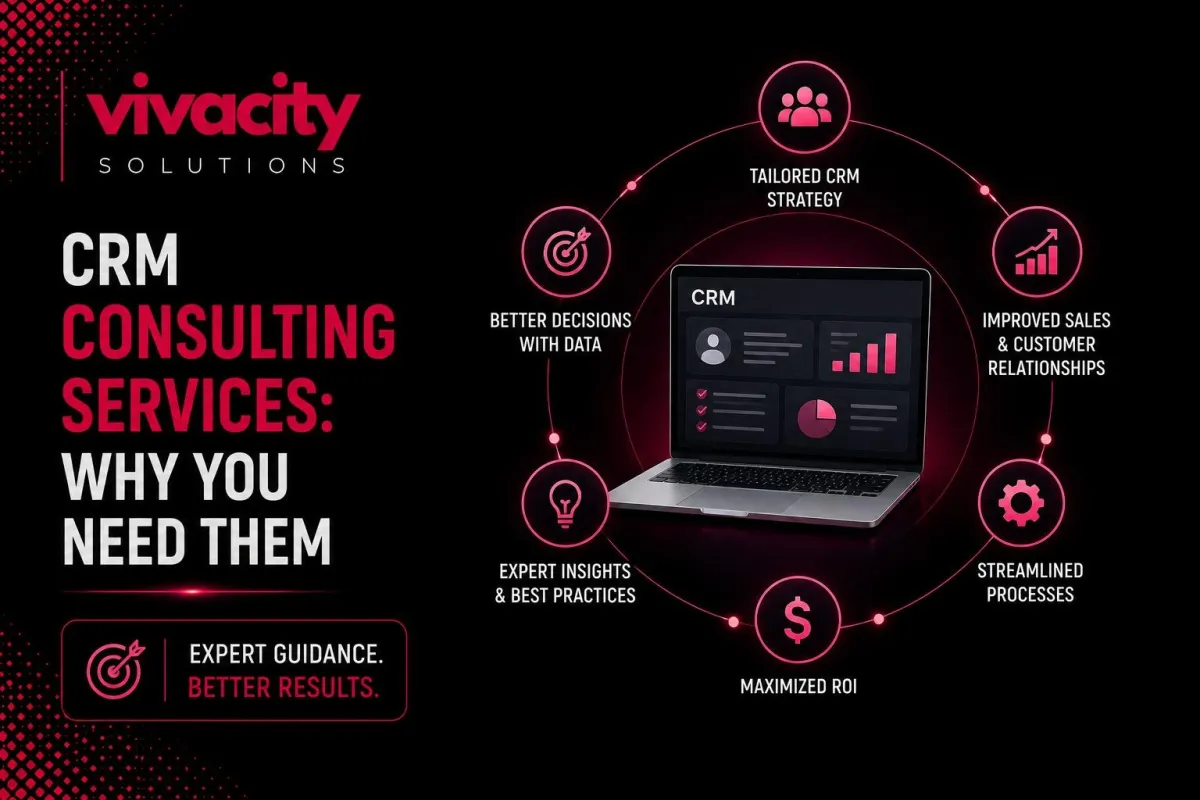
CRM Consulting Services: Why You Need a CRM Consultant
Here is a confession I hear from business owners almost every week. "We bought a CRM system two years ago. We spent a fortune on licenses. But our team hates it. Data is a mess. Nobody uses it. We are thinking of switching to another vendor. But we are afraid the same thing will happen again."
This story is painfully common. Research shows that about 42% of businesses struggle because they lack the know‑how to make their CRM work well. Companies that do not optimize their CRM installations receive far lower returns compared to those that work with experts.
The problem is rarely the CRM software itself. The problem is the lack of a CRM consultant who can guide you through the entire lifecycle – from selection to implementation to ongoing optimization. A professional CRM consultant turns your CRM system from an expensive database into a revenue‑driving engine.
In short, a CRM consultant helps you select, implement, and optimize your CRM system. They bring expertise in data migration, integration, training, and analytics, ensuring you get real ROI from your CRM investment.
This guide uses real‑world examples and current CRM trends to help you decide when and why to hire a CRM consultant in 2026.
Written by Michael Vivacity, CRM Strategy Lead at Vivacity Solutions. I have worked as a CRM consultant for over a decade, helping businesses of all sizes transform their customer relationships.
What Is a CRM Consultant?
A CRM consultant is a professional who helps businesses select, implement, customize, and optimize customer relationship management systems. They bring expertise in CRM implementation, CRM integration, CRM analytics, and CRM technology to ensure your CRM project delivers real business value.
A good CRM consultant does not just know the software. They understand business strategy, business goals, and how to align CRM solutions with your specific needs. They act as a bridge between your IT resources and your sales, marketing, and service teams.
Without a CRM consultant, you are flying blind. You might choose the wrong CRM software, configure it poorly, fail to integrate it with other tools, or struggle with user adoption. A CRM consultant prevents these costly mistakes.
If you are new to CRM fundamentals, understanding what is CRM is the first step. A CRM consultant can help you understand the types of CRM systems and which one fits your business.
What Does a CRM Consultant Actually Do?
A CRM consultant wears many hats. Their role goes far beyond "installing software." Here is what a professional CRM consultant actually does for your business.
CRM Consultant Maps Your Current Business Processes
They sit down with your sales, marketing, and service teams to understand how you work today. Where do leads come from? How are they assigned? What stages do deals go through? How do support tickets get handled? This process mapping is the foundation of any successful CRM implementation.
CRM Consultant Helps You Select The Right Crm Software
With hundreds of options available, choosing the right platform is overwhelming. A CRM consultant evaluates your needs, budget, and technical capabilities to recommend the best fit. They also help you understand CRM vs ERP if you need broader business systems.
CRM Consultant Manages Crm Data Migration
They clean your existing customer data, remove duplicates, standardize formats, and map fields to the new system. This is one of the most critical steps in any CRM project. Dirty data ruins even the best CRM system.
Crm Consultant Configures And Customizes Your Crm System
They set up CRM sales pipeline stages, custom fields, validation rules, and CRM workflow automation. They also integrate your CRM with other tools, email, calendar, marketing automation, ERP, and customer support. This is where CRM integration with marketing automation tool expertise is invaluable. Understanding what is crm integration helps you appreciate the complexity involved.
CRM Consultant Trains Your Team And Drives Adoption
They create training materials, run workshops, and provide ongoing support. They understand that CRM implementation is not just about technology; it is about people. Without user adoption, your CRM software is worthless. Many consultants also guide teams on CRM best practices to ensure long‑term success.
CRM Consultant Provides Ongoing Crm Analytics And Optimization
They set up reporting dashboards, monitor usage, and identify areas for improvement. They help you measure customer satisfaction, customer retention, and return on investment (ROI)
For complex or custom needs, a CRM consultant may also work alongside CRM Development Services and a CRM Development Partner to build tailored solutions.
Why Does Your Business Need a CRM Consultant?
Let me give you five compelling reasons to invest in CRM consulting services.
Avoid Costly Implementation Mistakes
CRM implementation is complex. Without expert guidance, you are almost certain to make mistakes. Common errors include skipping data cleanup, over‑automating too soon, ignoring user training, poor integration planning, and underestimating the timeline.
A CRM consultant has seen these mistakes hundreds of times. They know how to avoid them. They bring proven methodologies and best practices that reduce risk and accelerate your timeline. Companies that work with a CRM implementation consultant reduce project timelines by up to 40%.
CRM integration mistakes are particularly common and costly. A CRM consultant ensures your integrations are planned, tested, and maintained properly.
Maximize Your Return on Investment
CRM software is expensive. Licenses, customization, integration, training – it adds up fast. Without a CRM consultant, you risk wasting that investment.
Research from 2026 shows that companies that optimize their CRM installations with expert help receive an average 3.8 times return on investment compared to those who simply purchase the software. Organizations that use a unified CRM and AI consulting partner report 20‑35% lower total project costs and 40‑60% faster time‑to‑value.
A CRM consultant ensures you actually use the features you paid for. They help you unlock the full capabilities of your CRM platform and achieve business goals faster. This includes leveraging CRM automation tools and CRM automation services to streamline workflows.
Improve User Adoption and Team Productivity
Low user adoption is the number one reason CRM projects fail. Your team will not use a system that is confusing, slow, or irrelevant to their daily work.
A CRM consultant designs the system around how your team actually works. They simplify workflows, remove unnecessary fields, and automate repetitive tasks. They also provide hands‑on training and ongoing support.
Expert‑level CRM execution improves conversion rates, shortens sales cycles, and increases forecast accuracy. Companies that partner with CRM consultants outperform competitors by 28% in customer retention and 34% in operational efficiency.
Gain Strategic Customer Insights
CRM analytics is powerful, but only if you know how to use it. A CRM consultant helps you define the right metrics, build meaningful dashboards, and interpret the data.
With expert help, you gain customer insights that drive better decisions. You learn which lead sources produce the highest quality customers. You see where deals get stuck. You predict revenue with confidence. You improve customer experience and customer satisfaction. This is particularly valuable when combining CRM and marketing automation to align sales and marketing efforts.
CRM consulting focuses on making your CRM usable, accurate, and scalable. It aligns sales stages with the customer journey and ensures data is clean and structured properly.
Stay Ahead of Technology Trends
CRM technology evolves rapidly. In 2026, generative AI in CRM and AI agents are transforming how CRM systems work. AI‑integrated CRMs now deliver an average $8.71 ROI per dollar invested.
A CRM consultant stays current with these trends. They can advise you on when to adopt new features, how to leverage AI, and what integrations will give you a competitive edge. They help you avoid the trap of paying premium rates for AI‑generated outputs that could be done more cheaply.
To learn more about AI in CRM, read How Generative AI Is Transforming Modern CRM Systems.
DIY CRM Implementation vs. Working with a CRM Consultant
Many business owners wonder whether they can handle CRM implementation on their own. Let me compare the two approaches.
DIY CRM implementation relies on your internal team. This might work if you have experienced IT resources and team members who understand CRM software deeply. However, most businesses lack this expertise. The result is often a system that is poorly configured, lightly adopted, and underutilized. The timeline is uncertain, the risk of errors is high, and the cost of fixing mistakes can exceed the cost of hiring a consultant upfront.
Working with a CRM consultant brings proven methodology, a faster timeline, reduced risk, and higher adoption. The upfront cost is higher, but the ROI is significantly better. A consultant brings experience from dozens of similar projects. They know the common pitfalls and how to avoid them. They accelerate your timeline and reduce risk.
Companies that work with a CRM consultant report 40‑60% faster time‑to‑value compared to DIY implementations. For most businesses, the investment in CRM consulting services pays for itself within six to twelve months.
Real example: A mid‑sized B2B company hired a CRM consultant to fix their underperforming Salesforce system. Within 90 days, user adoption jumped from 35% to 92%, and forecast accuracy improved by 40%. The consultant's fee was recovered within four months through increased sales productivity alone.
If you are considering a custom build, you might also need CRM Development Partner services alongside consulting.
When Should You Hire a CRM Consultant?
Not every business needs a CRM consultant for every situation. Here are clear signs that it is time to bring one on board.
You are selecting a new CRM system. The market is overwhelming. A CRM consultant helps you evaluate options based on your specific needs, not just feature checklists. They consider your CRM Features requirements and compare types of CRM systems.
Your current CRM is underutilized. You are paying for features nobody uses. Your team complains that the system is "too complicated." A CRM consultant can optimize your existing setup and help your team understand how to use CRM effectively.
You are migrating to a new platform. CRM data migration is risky. A CRM consultant ensures your data is clean, mapped correctly, and transferred without loss.
You need integration with other systems. Connecting your CRM to email, marketing automation, ERP, or customer support requires expertise. A CRM consultant handles CRM integration so everything works seamlessly. This is where understanding Integrating CRM with Marketing Automation Tools and CRM-ERP Integration becomes valuable.
Your team is struggling with adoption. Training is not a one‑time event. A CRM consultant provides ongoing support, coaching, and resources to drive adoption.
You want to improve CRM analytics. You have data but no insights. A CRM consultant builds dashboards, defines KPIs, and helps you make data‑driven decisions.
You are planning for growth. As your business scales, your CRM system must scale with you. A CRM consultant helps you plan for the future and avoid bottlenecks.
For industry‑specific needs, a CRM consultant can also provide tailored advice for CRM for service-based businesses, or how a CRM can change Your Real Estate Business.
How to Choose the Right CRM Consultant
Not all CRM consultants are created equal. Here is how to choose the right one for your business.
Look For Relevant Industry Experience
A CRM consultant who has worked with businesses similar to yours understands your unique challenges and workflows. Ask for case studies and client references.
Evaluate Their Technical Expertise
Do they know your CRM software platform inside out? Can they handle CRM integration, CRM customization, and CRM data migration? For enterprise needs, look for specialists in platforms like Salesforce, Microsoft Dynamics, or HubSpot.
Assess Their Strategic Thinking
A good CRM consultant does not just configure software. They understand business strategy, business goals, and strategic planning. They ask questions about how you sell, market, and serve customers.
Check Their Approach To Change Management
CRM implementation is about people as much as technology. Your CRM consultant should have a clear plan for training, adoption, and ongoing support. They should be familiar with CRM best practices and CRM adoption strategies.
Consider Their Long‑term Partnership Model
CRM system optimization is ongoing. Choose a CRM consultant who offers post‑implementation support, not just a one‑time project. Look for CRM Services that include ongoing maintenance.
Evaluate Their Pricing Model
Some CRM consultants charge hourly rates ($100‑$500+). Others offer fixed‑fee packages. Understand what is included and what is extra.
Assess Their AI Readiness
In 2026, generative AI in CRM is transforming the landscape. Your CRM consultant should understand how to leverage AI for lead scoring, forecasting, and automation.
For platform‑specific expertise, you might look for a Salesforce consultant, a Microsoft Dynamics 365 consultant, or a HubSpot consultant. Many CRM consulting services firms offer expertise across multiple platforms.
How Much Does a CRM Consultant Cost?
CRM consultant fees vary widely based on expertise, project scope, and location. Here is a realistic breakdown.
Hourly rates for independent CRM consultants typically range from $100 to $250 per hour for mid‑level expertise and $250 to $500+ per hour for senior consultants with specialized skills.
Fixed‑fee projects are more common for well‑defined scopes. A small business CRM implementation might cost $5,000 to $15,000. A mid‑market project with customization and integrations typically ranges from $20,000 to $50,000. An enterprise deployment with custom development, multiple integrations, and extensive training can cost $100,000 or more.
Packaged services are becoming popular. Many CRM consulting services firms offer tiered packages based on business size and complexity. These include discovery, implementation, training, and post‑launch support.
Ongoing support and optimization typically costs 15‑20% of the initial implementation fee annually. This covers system updates, user training refreshers, and minor enhancements.
When evaluating CRM implementation cost, consider the cost of not hiring a consultant. A failed implementation wastes your software investment and demoralizes your team. It is worth spending more up front to get it right.
For accurate budgeting, request quotes from multiple CRM implementation companies or CRM implementation experts. Many offer free assessments. Also, read CRM implementation cost estimation guides for your specific CRM platform.
The Future of CRM Consulting: AI and Automation
CRM consulting is evolving rapidly. In 2026, AI is transforming how CRM consultants work.
AI agents are becoming operational teammates inside CRM implementations. Instead of users manually performing every task, AI agents now handle large portions of operational workflows. This is where generative AI in CRM is making a significant impact.
A forward‑thinking CRM consultant leverages AI to generate process documentation, summarize discovery sessions, and automate routine configuration tasks. They also help you integrate AI capabilities into your CRM for lead scoring, forecasting, and personalized outreach.
However, be cautious. Some enterprise CRM providers are replacing senior consultancy thinking with AI‑generated outputs while continuing to charge premium rates. A trustworthy CRM consultant is transparent about how they use AI and ensures you get genuine human expertise where it matters most.
The future of CRM consulting will see consultants becoming more like strategic advisors who help businesses navigate the complex AI‑CRM landscape. They will not just configure software – they will help you rethink how you manage customer relationships in an AI‑driven world.
To stay ahead, read How Generative AI Is Transforming Modern CRM Systems and " Generative AI in CRM.
Final Thought
A CRM consultant is not an expense. It is an investment in the success of your CRM system and your business. Without expert guidance, you risk low adoption, data chaos, integration failures, and wasted budget. With a CRM consultant, you gain strategic alignment, clean data, automated workflows, actionable insights, and a system that actually drives growth.
The CRM consulting services market is growing rapidly, valued at over $20 billion in 2025 and projected to reach nearly $30 billion by 2032. Businesses are realizing that CRM software alone is not enough. You need the expertise to make it work.
Do not let your CRM become another expensive shelfware. Hire a CRM consultant who understands your business, your customers, and your goals. Your team, and your bottom line, will thank you.
For ongoing success, explore CRM Services that include consulting, implementation, training, and support. And always keep learning about CRM best practices as your business evolves.
FAQs
What is a CRM consultant?
A CRM consultant is a professional who helps businesses select, implement, customize, and optimize customer relationship management systems. They align CRM technology with business goals, improve user adoption, and maximize ROI.
Why do businesses need CRM consulting services?
Businesses need CRM consulting services because CRM implementation is complex. Without expert guidance, companies face low adoption, data migration issues, integration failures, and poor ROI. A consultant brings experience, best practices, and strategic thinking.
What does a CRM consultant do?
A CRM consultant maps business processes, cleans and migrates data, configures the CRM system, integrates with other tools, trains users, and provides ongoing support and optimization.
When should you hire a CRM consultant?
Hire a CRM consultant when you are selecting a new CRM, your current system is underutilized, you are migrating to a new platform, you need integration with other systems, or your team is struggling with adoption.
How much does a CRM consultant cost?
CRM consultant fees vary widely. Hourly rates range from $100 to $500+. Fixed‑fee projects range from $5,000 for small implementations to $100,000+ for enterprise deployments. Many consultants offer packaged services for predictable pricing.
What is the ROI of hiring a CRM consultant?
Companies that work with CRM consultants achieve an average ROI of 3.8x compared to those that implement CRM without expert help. They also see faster implementation, lower costs, and higher user adoption.
What is the difference between CRM consulting and CRM implementation?
CRM consulting is a broader service that includes strategy, selection, process mapping, and optimization. CRM implementation is a subset that focuses specifically on configuring and deploying the software. Most consultants offer both.
Can a CRM consultant help with CRM integration?
Yes. CRM integration is a core service offered by CRM consultants. They connect your CRM with email, marketing automation, ERP, customer support, and other business tools.
What is CRM analytics?
CRM analytics is the process of analyzing customer data within your CRM system to gain insights into sales performance, customer behavior, and forecast accuracy. A CRM consultant helps set up analytics dashboards and interpret the data.
How does a CRM consultant improve customer retention?
By optimizing your CRM system, a consultant ensures you have complete customer history, automated follow‑ups, and proactive engagement. This leads to higher customer satisfaction and retention.
