CRM Implementation Cost vs Value: A Complete ROI Guide
Here is a question I hear from business owners almost every week. "We are thinking about getting a CRM system. But the costs seem overwhelming. Software licenses, setup, customization, and training. Is it really worth it? Will we ever see a return on this investment?"
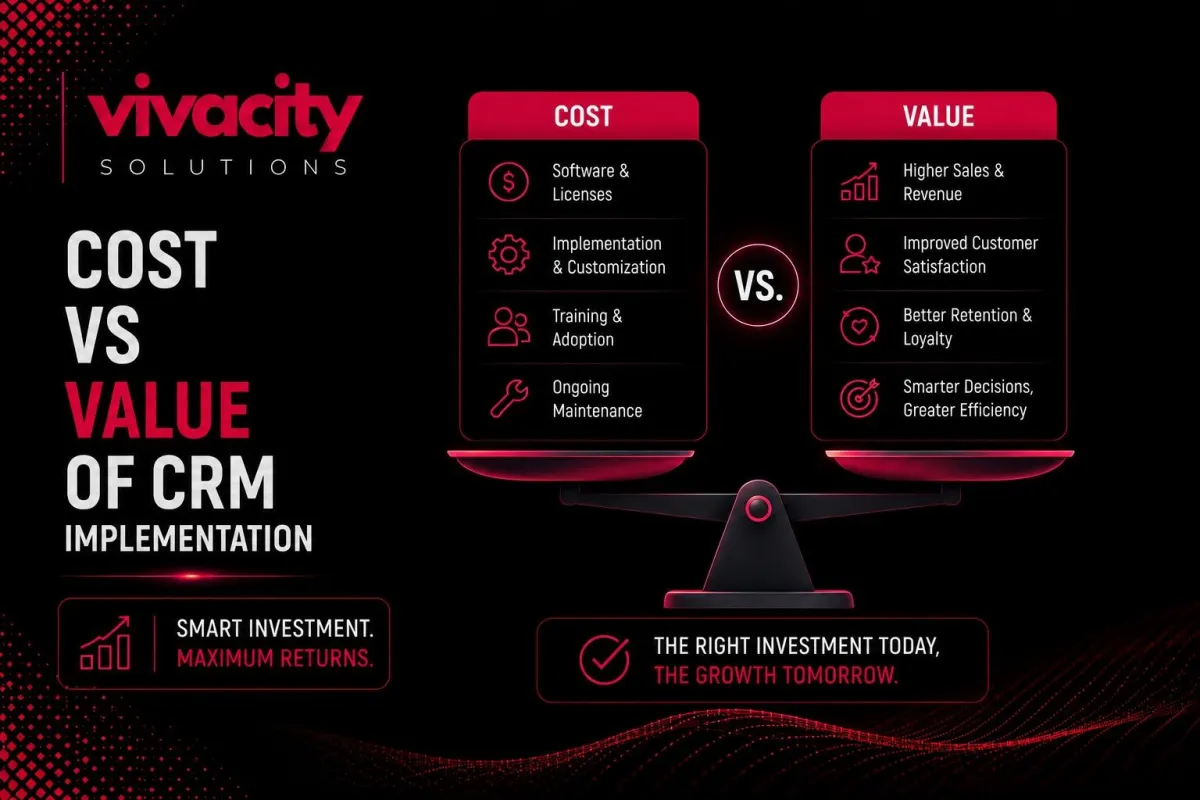
This is one of the most important questions you can ask. CRM implementation cost is high. But so is the value. Understanding the full CRM implementation cost – including hidden costs – and comparing it to the potential ROI is essential for making a smart decision.
What is the true cost of CRM implementation, and is it worth the value?
Before we dive deep, let me answer this directly. The average CRM implementation cost ranges from $10‑$50 per user per month for software, plus $5,000‑$50,000 for professional implementation services. Hidden CRM costs include data migration, integration, customization, training, and ongoing support. These can add 30‑50% to your total cost. The value, however, is substantial. Companies that implement CRM effectively achieve 3:1 to 8:1 ROI, with AI‑integrated CRM systems delivering over $8.70 per dollar invested. When measured against business growth, customer retention, and operational efficiency, the value far outweighs the cost.
This guide breaks down the true cost of CRM implementation, compares it to the value, and helps you make a confident investment decision.
Written by Michael, CRM Strategy Lead at Vivacity Solutions. I have helped over one hundred businesses evaluate CRM costs and maximize ROI.
Why Understanding CRM Implementation Cost Matters
Understanding the full CRM implementation cost matters because it is a significant business investment. The average CRM cost for a small business can range from $1,000‑$5,000 per year for software alone, while enterprise CRM systems can cost $100,000+ annually.
Without a clear understanding of CRM pricing, you risk budget overruns, unexpected expenses, and failure to achieve the expected value. Many businesses only consider the software subscription cost and overlook hidden CRM costs like data migration, integration, customization, and training.
CRM implementation cost also helps you build a strong business case for the investment. When you can show the expected ROI, you can secure budget and stakeholder buy‑in.
CRM implementation cost varies widely based on your business size, chosen CRM platform, level of CRM customization, and CRM implementation approach. A structured CRM implementation strategy and CRM implementation plan help you control costs and maximize value.
If you are new to CRM fundamentals, understanding what is CRM is the first step. A clear CRM implementation process is the second.
Breaking Down the True CRM Implementation Cost
Let me break down the full CRM implementation cost into its components.
CRM Software Pricing
CRM software pricing is the most visible cost. Most CRM systems use a subscription model, charging per user per month. Here is a typical breakdown:
CRM software pricing is the most visible cost. Most CRM systems use a subscription model, charging per user per month. Free plans are available from many providers, offering basic contact management with limited users.
Basic or starter plans typically range from $10 to $30 per user per month and include contact management, basic reporting, and limited automation. Professional plans, priced between $30 and $80 per user per month, offer advanced automation, lead management, pipeline tracking, and comprehensive reporting.
Enterprise plans, ranging from $80 to over $300 per user per month, provide full features including AI capabilities, advanced customization, and dedicated support. CRM software cost for small businesses typically falls in the $10 to $50 per user per month range, while enterprise CRM solutions can exceed $150 to $300 per user per month.
The average CRM cost per user is approximately $50 to $75 per month for mid‑market solutions. CRM pricing comparison across vendors is essential to find the best value for your specific needs.
CRM Features like automation, analytics, and integration are often only available in higher tiers, so understanding types of CRM systems helps you choose the right one for your business size and requirements.
CRM software cost for small businesses typically falls in the $10‑$50 per user per month range. Enterprise CRM solutions can exceed $150‑$300 per user per month.
The average CRM cost per user is approximately $50‑$75 per month for mid‑market solutions. CRM pricing comparison across vendors is essential to find the best value.
CRM Features like automation, analytics, and integration are often only available in higher tiers. Understanding types of CRM systems helps you choose the right one.
CRM Setup and Configuration Costs
CRM setup costs include configuring the system to match your sales pipeline management and business processes. This involves setting up stages, fields, user roles, and permissions.
For basic CRM setup, costs are often included in the subscription. For more complex CRM configuration, expect to pay $500‑$5,000 depending on complexity.
CRM implementation with professional services typically costs $5,000‑$50,000, depending on business size and complexity. CRM implementation services from vendors or partners can be worth the investment.
CRM Data Migration Costs
CRM data migration is one of the most overlooked CRM implementation costs. Moving customer data from spreadsheets, legacy systems, or other CRMs requires time and expertise.
Data migration costs depend on the volume of data, data quality, and the complexity of mapping. Basic migration might cost $500‑$2,000. Complex migration with cleaning and transformation can cost $5,000‑$20,000.
Skipping data migration cleanup is a common CRM implementation failure. Poor data quality leads to poor adoption and poor results.
CRM Integration Costs
CRM integration with marketing tools, email, marketing automation, ERP, customer support, and accounting- adds to the cost. Some integrations are native and free. Others require custom development.
CRM integration costs range from $500 for simple native connectors to $10,000‑$50,000 for complex custom integrations. CRM integration mistakes can be costly, so working with an experienced partner is recommended.
CRM-ERP Integration and Integrating CRM with Marketing Automation Tools are common integration projects that add to the cost but deliver significant value.
CRM integration with existing systems ensures data flows automatically, reducing manual work and improving accuracy.
CRM Customization Costs
CRM customization allows you to tailor the CRM system to your specific workflows. Custom fields, custom objects, custom workflows, and custom reports.
Basic customization is often included. Extensive customization can cost $5,000‑$50,000 or more. Custom CRM development is a larger investment, but it delivers a system perfectly aligned with your needs.
CRM Development Services and a can help with complex customization.
CRM Training Costs
CRM training is essential but often underinvested. Without training, CRM adoption suffers, and the CRM investment is wasted.
Training costs range from $500 for basic online tutorials to $5,000‑$20,000 for comprehensive, role‑based training programs. CRM adoption strategies and CRM training are critical for success.
CRM Implementation Failures are often caused by insufficient training. Investing in training is essential for realizing the value.
Ongoing CRM Support and Maintenance Costs
Ongoing support and maintenance are often overlooked in CRM implementation costs. Software updates, user support, system optimization, and additional storage.
Support costs typically range from 15‑20% of the initial implementation cost annually. Many vendors offer support packages ranging from $500‑$5,000 per year.
CRM Services and CRM consulting services can provide ongoing support and optimization.
Hidden CRM Costs You Need to Know About
Beyond the visible costs, there are hidden CRM costs that catch many businesses off guard.
Additional storage costs. As your business grows, so does your data. Most CRMs charge for additional storage beyond the included limits.
Premium feature costs. Many advanced CRM features, like AI, advanced analytics, or custom reporting, are only available in premium tiers.
API call overages. If your CRM integration or automation exceeds API call limits, you will incur additional charges.
Add‑on and app costs. The CRM platform ecosystem includes many add‑ons and apps that add functionality but also add cost. CRM add‑ons and CRM plugins can significantly increase the total cost.
Cost of downtime and errors. A poorly implemented CRM system leads to lost productivity, data errors, and frustrated users. These are not line‑item costs, but they are real.
Opportunity cost. The cost of not implementing a CRM system, lost sales, poor customer retention, and inefficient processes, is the highest hidden cost of all.
Understanding these hidden CRM costs helps you budget accurately. CRM integration with your existing tools often requires additional investment but delivers significant value.
The Value of CRM Implementation
Now, let me talk about the value that justifies the CRM implementation cost.
Increased Sales and Revenue
A CRM system directly improves sales and revenue. By providing better lead management, sales pipeline management, and sales automation, your team closes more deals faster.
Companies that use CRM effectively see a 29% increase in sales revenue. Sales pipeline management and sales forecasting become more accurate, enabling better planning.
CRM automation tools and CRM workflow automation reduce manual work, allowing your team to focus on selling. CRM Features like lead scoring and automated follow‑ups drive revenue growth.
Improved Customer Retention
CRM for customer retention is one of the most valuable benefits. By tracking customer data, managing customer relationships, and enabling proactive engagement, CRM reduces customer churn.
Increasing customer retention by 5% can increase profits by 25‑95%. Customer retention is far more profitable than acquisition. CRM systems are essential for retention.
CRM Increases Customer Retention by providing the tools and data needed to build lasting relationships.
Enhanced Productivity and Efficiency
CRM system implementation automates repetitive tasks, centralizes information, and streamlines workflows. This leads to significant operational efficiency gains.
Sales reps spend less time on data entry and more time selling. Service agents resolve issues faster with a complete customer history. Managers make better decisions with real‑time data.
CRM automation and task automation drive productivity. CRM tools and CRM solutions are designed to make your team more efficient.
Better Data‑Driven Decisions
A CRM system provides rich CRM analytics and CRM reporting that enable data‑driven decisions. You can track sales performance, customer satisfaction, and business growth in real time.
CRM analytics and CRM reporting dashboards give you visibility into what is working and what is not. This enables continuous CRM system optimization and CRM strategy refinement.
Measuring CRM ROI is essential for understanding the value and justifying the CRM implementation cost. CRM Features like analytics and reporting are critical.
CRM ROI: Is It Worth the Investment?
The average CRM ROI ranges from 3:1 to 8:1, meaning businesses typically earn $3 to $8 for every dollar invested in their CRM system. AI‑integrated CRM systems can deliver over $8.70 ROI per dollar invested.
Let me give you a real example. A mid‑sized B2B company invested $150,000 in CRM implementation. In the first year, they saw a 25% increase in conversion rates (worth $400,000), a 15% reduction in sales cycle length (worth $100,000 in productivity), and a 10% improvement in customer retention (worth $150,000). Total benefits = $650,000. ROI = ($650,000 – $150,000) / $150,000 × 100 = 333%.
The CRM system cost is high, but the value is greater. Companies that implement CRM effectively see strong returns. CRM implementation done correctly is the foundation for strong ROI.
How Generative AI Is Transforming Modern CRM Systems is a key trend. AI‑powered CRM systems can deliver significantly higher ROI through predictive analytics and automation.
Generative AI in CRM can automate lead scoring, content creation, and personalization, further increasing value.
CRM Implementation Cost by Business Size
CRM implementation cost varies significantly by business size.
Small business CRM cost. For small businesses (1‑10 users), CRM software costs typically range from $10‑$50 per user per month. CRM setup and basic configuration are often included. CRM implementation costs $500‑$5,000. Total annual cost: $1,000‑$10,000.
Mid‑market CRM cost. For mid‑sized businesses (10‑100 users), CRM pricing ranges from $50‑$100 per user per month. CRM implementation with customization and integration costs $10,000‑$50,000. Total annual cost: $20,000‑$150,000.
Enterprise CRM cost. For large enterprises (100+ users), CRM software costs range from $100‑$300+ per user per month. CRM implementation with custom development and complex integration costs $50,000‑$500,000+. Total annual cost: $150,000‑$1,000,000+.
CRM software for small businesses often offers affordable entry points. Enterprise CRM solutions require significant investment but deliver substantial value at scale.
CRM implementation cost also depends on the chosen CRM platform. Some CRM providers like HubSpot offer free plans for small businesses. Others, like Salesforce, require significant investment.
How to Reduce CRM Implementation Costs
Here are practical ways to reduce CRM implementation cost without sacrificing value.
Choose the right CRM software for your size. Do not buy an enterprise solution for a small team. CRM software for small businesses offers affordable plans with the features you need.
Start with core features. Use the CRM features that deliver the most value first. Add advanced features later as your business grows and your needs evolve.
Do a thorough data cleanup yourself. CRM data migration costs can be reduced by cleaning your data before engaging a consultant.
Train internal champions. Instead of paying for extensive external training, appoint CRM champions within your team who can train others.
Choose a CRM with strong native integrations. Native CRM integration reduces the need for costly custom development.
Plan your CRM implementation carefully. A clear CRM implementation strategy and CRM implementation plan prevent costly mistakes.
ork with an experienced CRM consultant. The right CRM consultant or CRM implementation partner may cost more upfront, but prevents costly errors. CRM consulting services can help you avoid costly mistakes that reduce ROI.
CRM implementation costs can be managed with the right approach.
DIY vs. Working with a CRM Implementation Partner
Many business owners wonder whether to handle CRM implementation themselves or work with a partner. Let me compare the two approaches.
DIY CRM implementation relies on your internal team. This can work if you have experienced staff and simple needs. However, most businesses lack the expertise and time. The result is often CRM implementation failures, low CRM adoption, and poor ROI. The CRM implementation cost may seem lower, but the value is also lower.
Working with a CRM implementation partner brings proven expertise, faster implementation, and higher success rates. A CRM implementation company or CRM development partner can help you configure the system, migrate data, integrate with existing tools, and train your team. The upfront cost is higher, but the ROI is significantly better.
CRM implementation services from an experienced partner reduce the risk of costly mistakes. CRM consulting services and CRM development services ensure your CRM system is set up correctly from the start.
Companies that work with a CRM implementation partner achieve 40‑60% faster time‑to‑value and significantly higher ROI compared to DIY implementations.
CRM Services from an experienced provider can make the difference between a CRM system that delivers value and one that collects dust.
Final Thought
CRM implementation cost is high, but the value is greater. A properly implemented CRM system delivers strong ROI through increased sales, improved customer retention, enhanced productivity, and better data‑driven decisions.
The average CRM ROI ranges from 3:1 to 8:1, meaning businesses earn $3‑$8 for every dollar invested. When you consider the cost of not implementing a CRM, lost sales, poor retention, and inefficient processes, the case for investing becomes even stronger.
CRM implementation cost should not be viewed as an expense, but as an investment in your business. The key is to understand the full cost, choose the right CRM software, and implement it effectively.
Start today. Evaluate your needs. Research CRM pricing. Build a CRM implementation plan. And if you need help, work with an experienced CRM consultant or CRM implementation partner. Your investment will pay off.
For ongoing success, explore CRM Services that include consulting, implementation, training, and support. And always keep learning about CRM strategies as your business evolves.
FAQs
How much does CRM implementation cost?
CRM implementation cost ranges from a few hundred dollars for DIY setup to $10,000‑$50,000 for mid‑market projects and $100,000+ for enterprise implementations. The total cost includes software licenses, customization, data migration, integration, training, and ongoing support.
What is the average cost of CRM software per month?
CRM software pricing typically ranges from $10‑$50 per user per month for small business plans, $50‑$150 for professional plans, and $150‑$300+ for enterprise tiers. Many providers offer free plans with limited features.
What are the hidden costs of CRM implementation?
Hidden CRM implementation costs include data migration, integration with existing systems, customization, training, ongoing support, additional storage, and premium features. These can add 30‑50% to the total cost.
Is CRM implementation worth the cost?
Yes, when implemented properly, CRM delivers strong ROI. The average CRM ROI ranges from 3:1 to 8:1, meaning businesses earn $3‑$8 for every dollar invested. AI‑integrated CRMs can deliver over $8.70 ROI per dollar.
How can I reduce CRM implementation costs?
Reduce CRM implementation costs by choosing the right CRM software for your size, starting with core features, doing thorough data cleanup yourself, training internal champions, and working with an experienced CRM consultant who avoids costly mistakes.
What is the cost of CRM for a small business?
CRM software for small businesses typically costs $10‑$50 per user per month. Implementation costs $500‑$5,000. Total annual cost: $1,000‑$10,000.
What is included in CRM implementation services?
CRM implementation services typically include project management, configuration, data migration, integration, customization, training, and post‑launch support. The scope depends on the complexity of your implementation.
How long does CRM implementation take?
CRM implementation timeline ranges from 2‑4 weeks for simple setups to 6‑12 months for complex enterprise deployments. The timeline depends on the scope of customization, integration, and data migration.
What is the ROI of CRM implementation?
The average CRM ROI ranges from 3:1 to 8:1. Companies that implement CRM effectively see strong returns through increased sales, improved customer retention, and enhanced productivity.
What is the difference between CRM cost and CRM value?
CRM cost is the total investment, including software, implementation, training, and support. CRM value is the benefits delivered, increased sales, reduced churn, and improved efficiency. Value should exceed cost for a positive ROI.
