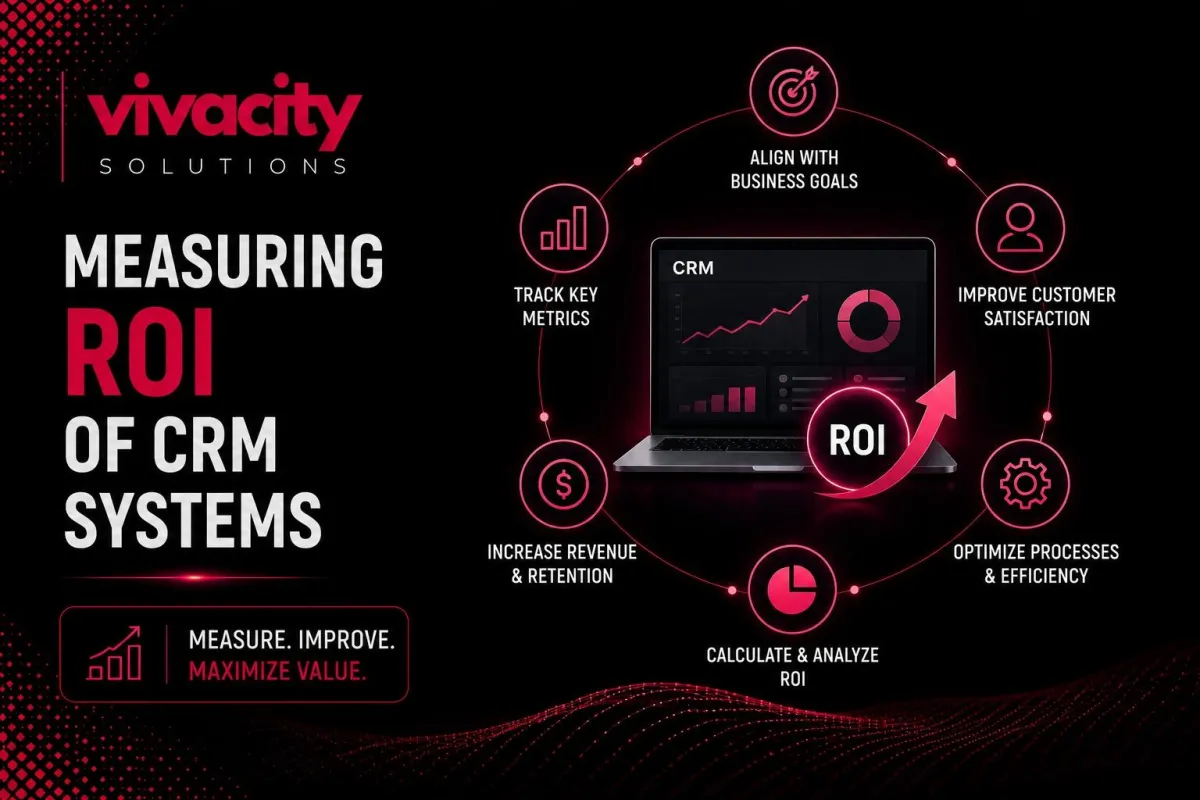
Measuring CRM ROI | How to Calculate Return on Investment
Here is a conversation I have with business owners almost every week. "We spent $50,000 on our CRM system last year. We have no idea if it is paying off. Our team uses it. But can we really say it is generating return on investment? How do we even measure that?"
This is one of the most common questions I hear. Companies invest heavily in CRM software, but they struggle to quantify the CRM ROI. Without measuring return on investment, you cannot justify the CRM investment, optimize performance, or make a case for additional spending.
Measuring CRM ROI is not as complicated as it seems. It is about tracking the right CRM metrics, establishing baseline metrics, and calculating the financial impact of your CRM system. When you get it right, you can prove the value of your CRM investment and identify opportunities for improvement.
What is the most effective way to measure CRM ROI?
Before we dive deep, let me answer this directly. The most effective way to measure CRM ROI is to calculate total benefits (increased sales, improved productivity, cost savings) minus total costs (software, implementation, training, support), divided by total costs, multiplied by 100. But that is just the formula. The real work is tracking the right CRM metrics before and after implementation, establishing baseline metrics, and continuously monitoring CRM performance.
This guide uses real‑world examples and proven frameworks to help you measure CRM ROI with confidence.
Written by Michael, CRM Strategy Lead at Vivacity Solutions. I have helped over one hundred businesses measure and optimize their CRM ROI.
Why Measuring CRM ROI Matters
Measuring CRM ROI matters because your CRM system is a significant investment. According to industry data, the average company spends between $50,000 and $500,000 on CRM software and CRM implementation, depending on size and complexity. That is a lot of money to spend without knowing if it is working.
When you measure CRM ROI, you gain several advantages. You can justify the CRM investment to stakeholders. You can identify which CRM features and CRM automation tools deliver the most value. You can optimize CRM strategy to improve business performance. And you can make a data‑driven case for additional investment.
Measuring CRM ROI also helps with CRM system optimization. By tracking CRM metrics, you can identify areas where the CRM system is underperforming. Maybe user adoption is low. Maybe a specific CRM feature is not being used. Maybe certain teams are not benefiting. These insights help you improve CRM strategies and maximize value.
Companies that consistently measure CRM ROI achieve 28% higher customer retention and 34% better operational efficiency compared to those that do not. They also report higher customer satisfaction and revenue growth.
If you are new to CRM fundamentals, understanding what is CRM is the first step. A strong CRM strategy with clear ROI measurement is the second.
What Is CRM ROI?
CRM ROI is the measure of the financial return you get from your CRM software relative to what you invested. It answers a simple question: for every dollar you spend on your CRM system, how many dollars do you get back?
Return on investment is typically expressed as a percentage or a ratio. A positive CRM ROI means your CRM investment is generating more value than it costs. A negative CRM ROI means you are losing money.
CRM ROI is not just about revenue. It also includes cost savings, productivity gains, and improved customer satisfaction. A CRM system might help your sales team close deals faster, reduce administrative work, or improve customer retention, all of which contribute to return on investment.
The average CRM ROI ranges from 3:1 to 8:1, meaning businesses typically earn $3 to $8 for every dollar invested. With proper implementation and CRM adoption strategies, AI‑integrated CRM systems can deliver over $8.70 ROI per dollar invested.
Understanding CRM vs ERP can help you distinguish between customer‑facing ROI (CRM) and operational ROI (ERP). Both are valuable, but the measurement approaches differ.
The CRM ROI Formula
The CRM ROI calculation is straightforward. Here is the formula:
(Total Benefits – Total Costs) / Total Costs × 100 = ROI Percentage
Let me break that down.
Total Benefits include all the financial gains from your CRM software. This includes increased sales, improved conversion rates, higher customer lifetime value, reduced churn, improved productivity, and cost savings.
Total Costs include everything you spent on your CRM system. This includes CRM software licenses, CRM implementation costs, CRM integration costs, customization, training, and ongoing support.
Calculating CRM ROI requires tracking benefits and costs over a specific period, typically one year. You establish baseline metrics before implementation, then measure the same metrics after implementation to see the difference.
Example: If your CRM investment costs $100,000 and generates $400,000 in benefits, your ROI is ($400,000 – $100,000) / $100,000 × 100 = 300%. That is a 3:1 return.
For a more accurate CRM software ROI calculation, consider the full lifecycle of your CRM system. Many businesses see ROI improve over time as users become more proficient and the system becomes more embedded in workflows.
CRM Features that drive ROI include automation, analytics, and integration capabilities. CRM automation tools can significantly reduce manual work, which directly impacts the benefits side of the equation.
Key CRM Metrics to Track
To measure CRM ROI, you need to track the right CRM metrics. Let me walk you through the most important categories.
Sales Growth and Revenue Metrics
Revenue growth is the most direct measure of CRM ROI. Track total revenue, deal size, and sales velocity before and after CRM implementation.
Conversion rates show how many leads become customers. A CRM system should improve conversion rates by using CRM for Lead Generation and Nurturing.
Sales cycle length measures how long it takes to close a deal. A CRM system should shorten the sales cycle through automation and better visibility.
Forecast accuracy improves when your team uses the CRM system consistently. Accurate forecasts help with resource planning and revenue predictions.
CRM analytics and CRM reporting dashboards can track these metrics automatically. CRM features like pipeline visualization and reporting are essential.
Customer Metrics
Customer retention rate measures how many customers stay with you over time. A CRM system should improve retention through better customer experience and proactive engagement.
Customer lifetime value (CLV) is the total revenue you can expect from a customer. Improving CLV is a key driver of CRM ROI.
Customer satisfaction scores (CSAT) and Net Promoter Scores (NPS) measure how happy your customers are. A CRM system should improve both through better service and personalization.
Churn rate measures how many customers leave. Reducing churn directly impacts ROI.
CRM and marketing automation tools can help improve customer metrics by enabling personalized outreach and timely follow‑ups.
Productivity and Efficiency Metrics
Sales productivity measures how much revenue your team generates per rep. A CRM system should increase productivity through automation and better organization.
Time saved on administrative tasks is a direct benefit of CRM automation tools. Calculate how many hours your team saves each week and multiply by their hourly cost.
Lead response time measures how quickly your team responds to new leads. A CRM system with automation should dramatically reduce response time.
Task completion rate measures the percentage of assigned tasks completed on time. The CRM system should improve this through better task management.
CRM workflow automation reduces manual work. CRM automation services can help you set up efficient workflows that save time and reduce errors.
Adoption and Usage Metrics
User adoption rate measures the percentage of your team that uses the CRM software consistently. Low adoption is the biggest threat to CRM ROI.
Login frequency tracks how often users log in. Daily login is a sign of strong adoption.
Data entry rate measures how consistently users update customer data. Clean data is essential for accurate CRM analytics.
Feature usage shows which CRM features are being used. Underutilized features may indicate training gaps or a poor CRM strategy.
CRM adoption strategies are critical for maximizing ROI. Without adoption, your CRM investment cannot deliver returns.
How to Calculate CRM ROI
Let me walk you through the CRM ROI calculation step by step.
Step one: Establish baseline metrics. Before you implement your CRM system, record your current performance on key CRM metrics. This is your starting point. Without baseline metrics, you cannot measure improvement.
Step two: Identify your CRM costs. Add up all costs associated with your CRM investment. Include CRM software licenses, CRM implementation costs, CRM integration costs, customization, training, and ongoing support.
Step three: Track post‑implementation metrics. Six to twelve months after CRM implementation, measure the same CRM metrics you recorded in step one.
Step four: Calculate benefits. For each metric, calculate the improvement and convert it to a financial value. For example, if your conversion rate increased from 20% to 30% and you generate 1,000 leads per year, that is an extra 100 customers at $5,000 each = $500,000 in additional revenue.
Step five: Calculate ROI. Apply the formula: (Total Benefits – Total Costs) / Total Costs × 100 = ROI Percentage.
Step six: Review and optimize. Use your CRM analytics to identify areas for improvement. Optimize CRM strategy, CRM training, and CRM adoption to increase ROI.
Real example: A mid‑sized B2B company invested $150,000 in a CRM system. In the first year, they saw a 25% increase in conversion rates (worth $400,000), a 15% reduction in sales cycle length (worth $100,000 in productivity), and a 10% improvement in customer retention (worth $150,000). Total benefits = $650,000. ROI = ($650,000 – $150,000) / $150,000 × 100 = 333%.
CRM implementation done correctly is the foundation for strong ROI. CRM implementation failures can severely impact returns.
Common CRM ROI Mistakes to Avoid
Measuring CRM ROI is not foolproof. Here are common mistakes.
Mistake 1: Not establishing baseline metrics. Without a starting point, you cannot measure improvement. Always record baseline metrics before implementation.
Mistake 2: Ignoring intangible benefits. CRM systems improve customer satisfaction, customer loyalty, and customer experience – all of which have financial value. Try to quantify these benefits.
Mistake 3: Focusing only on revenue. CRM ROI also comes from cost savings and productivity gains. Include these in your calculation.
Mistake 4: Measuring too early. CRM ROI takes time. Six to twelve months is the minimum.
Mistake 5: Ignoring adoption. Low adoption kills ROI. Track CRM adoption metrics and invest in CRM adoption strategies.
Mistake 6: Not optimizing. CRM ROI is not a one‑time calculation. Continuously monitor and optimize.
CRM integration mistakes can also negatively impact ROI. Poor integration creates data silos and reduces efficiency.
How to Maximize Your CRM ROI
Measuring CRM ROI is important, but maximizing it is even better. Here is how.
Invest in CRM adoption. The biggest driver of CRM ROI is user adoption. Follow CRM adoption strategies to ensure your team embraces the system.
Choose the right CRM software. Select a CRM platform that fits your business size, industry, and goals. CRM Features like automation, analytics, and integration should match your needs.
Optimize your CRM strategy. Continuously refine your CRM strategy based on CRM metrics. Remove friction, simplify workflows, and automate repetitive tasks.
Integrate with other tools. CRM integration with email, marketing automation, and ERP maximizes value. Seamless CRM integration ensures data flows automatically.
Invest in training. CRM training is not a one‑time event. Ongoing training ensures users stay proficient, and adoption remains high.
Use analytics and reporting. CRM analytics and CRM reporting help you identify areas for improvement. Use data to make decisions.
Consider CRM consulting services. A CRM consultant or CRM development partner can help you optimize your CRM system and maximize ROI.
How Generative AI Is Transforming Modern CRM Systems is a key trend. AI‑powered CRM systems can deliver significantly higher ROI through predictive analytics and automation. Generative AI in CRM can automate lead scoring, content creation, and personalization.
CRM-ERP Integration can also boost ROI by connecting customer data with operational data, enabling better decision‑making and efficiency.
Real‑World CRM ROI Examples
Let me give you real examples of measuring CRM ROI across different business types.
Example 1: B2B Sales Team. A software company with 20 sales reps invested in a sales CRM software. Before implementation, each rep managed 50 leads but closed only 5 deals per month. After CRM implementation, with better lead management and automation, each rep managed 80 leads and closed 8 deals per month. Revenue increased by 60%, and the CRM investment paid for itself in four months.
Example 2: Customer Service Team. A retail company used a CRM system to centralize customer service tickets. Before, response time averaged 12 hours. After, with automated routing and customer history, response time dropped to 2 hours. Customer satisfaction scores improved by 40%, and churn decreased by 15%. The CRM investment generated $200,000 in retained revenue.
Example 3: Marketing Team. A B2B marketing agency used CRM and marketing automation to personalize outreach. Before, they had a 10% conversion rate on leads. After, with targeted messaging and automated follow‑ups, conversion rates increased to 22%. The CRM investment generated $300,000 in additional revenue.
CRM for service-based businesses and How a CRM can change Your Real Estate Business provides more industry‑specific examples.
Final Thought
Measuring CRM ROI is not optional. It is essential. Without measurement, you cannot justify your CRM investment, optimize CRM performance, or make data‑driven decisions about your CRM strategy.
The CRM ROI formula is simple. But the real work is tracking the right CRM metrics, establishing baseline metrics, and continuously improving your CRM system.
The businesses that measure CRM ROI consistently outperform those that do not. They achieve higher revenue growth, better customer retention, and stronger business performance. They also make better decisions about CRM investment and CRM strategy.
Start today. Establish your baseline metrics. Track your costs. Measure your benefits. Calculate your ROI. Then optimize. Your CRM system can be a powerful driver of business growth, but only if you measure and manage it effectively.
For ongoing success, explore CRM Services that include consulting, implementation, and support. And always keep learning about CRM strategies as your business evolves.
FAQs
How do you measure CRM ROI?
To measure CRM ROI, calculate the total benefits from your CRM system (increased sales, improved productivity, cost savings) minus total costs (software licenses, implementation, training, support), then divide by total costs and multiply by 100 to get a percentage.
What is the average CRM ROI?
The average CRM ROI ranges from 3:1 to 8:1, meaning businesses typically earn $3 to $8 for every dollar invested. With proper implementation and adoption, AI‑integrated CRMs can deliver over $8.70 ROI per dollar invested.
What metrics should I use to measure CRM success?
Key CRM metrics include sales growth, conversion rates, customer retention rate, customer lifetime value, lead response time, sales cycle length, forecast accuracy, and user adoption rates.
How long does it take to see CRM ROI?
Most businesses see measurable CRM ROI within 6‑12 months. However, the timeline depends on implementation complexity, user adoption speed, and the specific benefits targeted (sales growth, operational efficiency, etc.).
What is the formula for calculating CRM ROI?
The CRM ROI formula is: (Total Benefits – Total Costs) / Total Costs × 100 = ROI Percentage. Benefits include increased revenue, cost savings, and productivity gains. Costs include software, implementation, training, and support.
What is a good CRM ROI?
A good CRM ROI is anything above 100%, meaning you earn more than you invested. Most businesses aim for 200‑300% (2‑3x return). Top performers achieve 500%+.
How does CRM adoption affect ROI?
CRM adoption is the biggest driver of ROI. Low adoption means low benefits. High adoption means the system is used consistently, data is accurate, and ROI increases.
What are baseline metrics?
Baseline metrics are your performance levels before CRM implementation. They provide a starting point for measuring improvement. Without baselines, you cannot calculate ROI.
How does CRM integration affect ROI?
Good CRM integration with email, marketing automation, and ERP increases ROI by reducing manual work and improving data accuracy. Poor integration creates friction and lowers ROI.
What is the ROI of custom CRM development?
Custom CRM development has higher upfront costs but can deliver higher ROI through tailored workflows, better efficiency, and competitive advantage. ROI depends on how well the custom solution meets your unique needs.
